
Imagine spending months designing a high-performance electrical system.
Every component has been carefully selected. The Connectors meet the required specifications, the Cable Assemblies have been professionally manufactured, and every electrical parameter has been verified. Factory acceptance testing is successful, installation goes smoothly, and everything appears ready for years of reliable operation.
Six months later, intermittent faults begin to appear.
Communication errors become more frequent. Maintenance engineers spend hours troubleshooting. Eventually, the system is partially dismantled, only to discover that the connector itself is still functioning exactly as intended.
The real problem sits just behind it.
The backshell.
Although backshells are often viewed as simple accessories, they are one of the most important components in a high-performance interconnect system. They protect the transition between the connector and the cable, reduce mechanical stress, improve shielding, and help ensure that a connection continues to perform under real-world operating conditions.
For industries such as aerospace, defence, industrial automation, offshore, robotics and transportation, overlooking the backshell can mean the difference between a system that operates reliably for decades and one that requires unexpected maintenance after only a short period of service. Incotech supplies a broad range of Connectoren en Backshells designed for exactly these demanding environments.
What Is a Backshell?
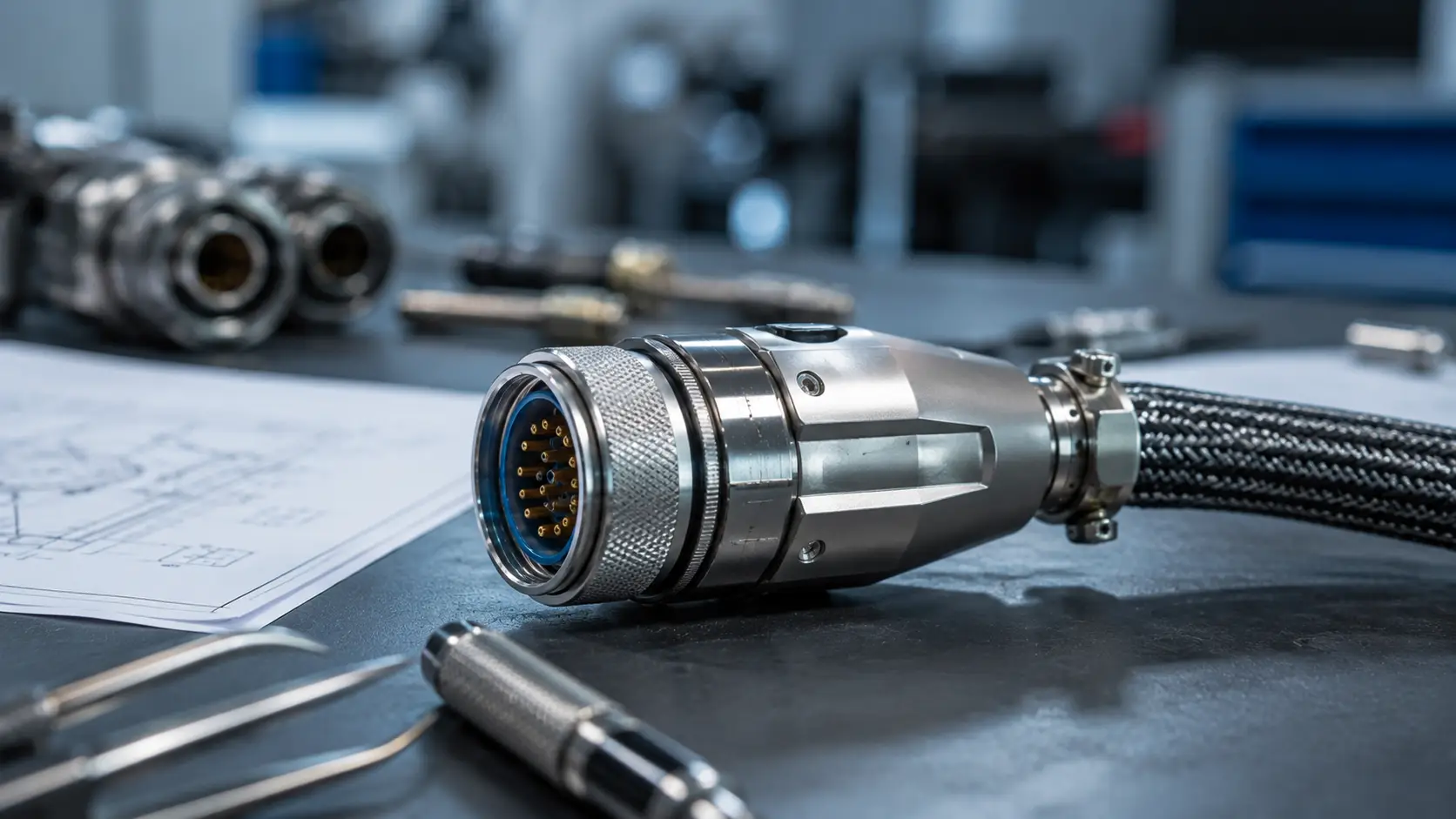
A backshell is mounted on the rear of a connector and forms the interface between the connector body and the cable.
While it doesn't carry electrical signals itself, it performs several critical mechanical and environmental functions that directly influence the reliability of the complete connection.
A properly selected Backshell can provide:
- strain relief
- cable support
- EMI/RFI shielding
- environmental sealing
- cable routing
- mechanical protection
- improved service life
Think of it as the component that protects everything engineers have worked so hard to achieve.
Without adequate protection at the cable entry point, even the highest-quality Connectors can become vulnerable to vibration, cable movement, contamination or electromagnetic interference. Incotech's backshell portfolio is specifically designed to improve reliability in harsh environments and supports both MIL-spec and circular connector systems.
Why Backshells Matter More Than Most Engineers Think
When engineers discuss connector performance, the conversation usually focuses on:
- contact arrangement
- current capacity
- voltage ratings
- IP protection
- material selection
Backshells rarely receive the same level of attention.
Yet in practice, they often determine how long a connector continues performing once the equipment enters service.
Every cable experiences movement.
Sometimes it's only a few millimetres.
Sometimes it's continuous vibration for years.
Without proper strain relief, every movement is transferred directly into the connector contacts.
Eventually this can result in:
- damaged conductors
- broken shielding
- intermittent communication
- increased maintenance
- unexpected downtime
A well-designed backshell prevents these forces from reaching the electrical termination by distributing mechanical loads safely across the cable. This is one of the primary reasons backshells are widely used in aviation, aerospace, defence, robotics and offshore applications.
More Than Just Cable Protection
One of the biggest misconceptions is that a backshell only prevents a cable from being pulled out of a connector.
In reality, modern backshells perform multiple functions simultaneously.
Let's take a closer look.
Mechanical Protection
Mechanical stress is unavoidable.
Industrial machinery vibrates.
Aircraft experience constant movement.
Offshore equipment is exposed to waves and wind.
Robotic systems repeat the same movements thousands of times every day.
Without proper support, these forces gradually weaken the cable termination.
Using the correct cable clamps together with an appropriate Backshell significantly reduces this mechanical stress while improving long-term durability. Incotech offers dedicated cable clamps and strain-relief solutions as part of its backshell range.
Strain Relief
If there is one feature engineers associate with backshells, it is strain relief.
For good reason.
Whenever a cable bends immediately behind a connector, the conductors inside are subjected to repeated stress.
Over time this may lead to:
- broken wires
- damaged insulation
- intermittent signals
- complete cable failure
Effective strain relief distributes bending forces over a much larger section of the cable.
Instead of concentrating stress at one critical point, movement is absorbed gradually.
This significantly extends the operational life of both the connector and the cable.
Applications experiencing continuous movement often combine strain reliefs, cable clamps and professionally designed Cable Assemblies to maximise reliability.
Environmental Protection
Not every electrical system operates inside a clean control cabinet.
Many systems are exposed to:
- rain
- humidity
- dust
- chemicals
- hydraulic fluids
- salt spray
- extreme temperatures
Over time, these environmental factors can affect cable terminations if they are not properly protected.
This is where environmental backshells become essential.
They help create an additional barrier between the connector and the outside environment, reducing the risk of contamination and extending the lifespan of the complete interconnect system. Environmental protection is one of the core functions highlighted within Incotech's backshell portfolio.
EMI and RFI Shielding
As electronic systems become faster and more connected, electromagnetic interference becomes increasingly important.
High-frequency applications are particularly sensitive to unwanted electrical noise.
Poor shielding can lead to:
- unstable communication
- corrupted data
- unexpected system behaviour
- reduced signal quality
Specialised EMI/RFI Backshells are designed to terminate cable shields correctly while maintaining shielding continuity between the cable and the connector.
Combined with high-quality Connectors and correctly manufactured cable assemblies, they help preserve signal integrity in demanding applications. Incotech specifically offers EMI and RFI backshell variants for this purpose.
Different Applications Require Different Backshells
One of the biggest mistakes engineers make is assuming that every backshell performs the same function.
In reality, each design is developed to solve a specific engineering challenge.
A backshell selected for an aircraft wiring harness may not be suitable for an offshore control cabinet.
Likewise, a solution intended for high-frequency defence electronics may be unnecessary for standard industrial automation.
Choosing the right backshell starts with understanding the application.
Questions worth asking include:
- Will the cable experience continuous movement?
- Is EMI shielding required?
- Will the equipment operate outdoors?
- Is weight a critical factor?
- Are chemicals or saltwater present?
- Will regular maintenance be required?
Answering these questions early allows engineers to select the most suitable Interconnect Solutions before the system reaches production, reducing redesigns and improving long-term reliability.
Not Every Backshell Is Designed for the Same Job
One of the biggest misconceptions in connector design is that a backshell is simply "something that screws onto the back of a connector."
In reality, backshells are engineered for very specific purposes.
Choosing the wrong type may not cause immediate problems during testing, but after months—or even years—of exposure to vibration, moisture or electromagnetic interference, the consequences can become apparent.
That's why selecting the right backshells should be considered just as carefully as selecting the connector itself. Incotech offers a wide range of backshell solutions, each designed for a specific application or operating environment.
Straight, 45° or 90°?
One of the first decisions engineers make is determining how the cable should leave the connector.
Although this might seem like a minor detail, it can have a major influence on cable routing, installation space and long-term reliability.
Straight Backshells
Straight backshells are the most common choice.
They are typically used when:
- sufficient installation space is available
- the cable can leave the connector without sharp bends
- simple routing is preferred
Straight configurations also simplify maintenance because technicians have easy access during installation or inspection.
45° Backshells
Space inside modern equipment is becoming increasingly limited.
A 45-degree backshell allows the cable to leave the connector at a gentler angle, reducing stress while improving cable routing.
Typical applications include:
- aerospace equipment
- electronic control cabinets
- compact industrial machinery
- communication systems
90° Backshells
Sometimes there simply isn't enough room behind a connector.
A 90-degree backshell redirects the cable immediately after it exits the connector, allowing engineers to reduce the overall installation depth.
These configurations are frequently used in:
- aircraft cabins
- military vehicles
- robotics
- railway applications
Choosing the correct angle isn't simply about making everything fit.
Good cable routing reduces mechanical stress, improves accessibility and often makes future maintenance much easier.
Shrink Boots: Small Component, Big Difference
When discussing connector protection, shrink boots deserve special attention.
At first glance they appear to be little more than flexible sleeves.
In reality, they perform several important functions simultaneously.
After installation and controlled heating, a shrink boot tightly conforms to both the backshell and the cable, creating an additional protective barrier.
Depending on the application, shrink boots help:
- reduce cable movement
- improve strain relief
- protect against moisture
- minimise contamination
- improve long-term durability
In demanding environments such as aerospace, offshore or defence systems, shrink boots are often considered an essential part of the complete cable termination rather than an optional accessory. Incotech supplies dedicated shrink boots and shrink adapters for these applications.
Environmental Backshells
Not every connector operates inside a clean, temperature-controlled environment.
Many systems spend years exposed to:
- heavy rain
- humidity
- sand
- dust
- chemicals
- hydraulic fluids
- salt spray
- extreme temperatures
These conditions place enormous stress on cable terminations.
While a connector may have an excellent environmental rating, the rear cable entry remains a potential weak point if it is not adequately protected.
This is exactly where environmental backshells become invaluable.
By creating an effective seal around the cable entry, they help reduce the ingress of moisture, dirt and contaminants that could otherwise affect long-term reliability. Environmental backshells are a core part of Incotech's product portfolio for harsh environments.
EMI and RFI Shielding: Protecting More Than Just the Cable
Modern electronic systems transmit enormous amounts of information.
Whether it's radar data, flight controls, industrial automation or high-speed communication, maintaining signal quality has become more important than ever.
Unfortunately, every cable can potentially act as both:
- an antenna receiving unwanted interference
- a source radiating electromagnetic noise
Without proper shielding, even perfectly functioning electronics may experience:
- communication errors
- corrupted data
- unstable sensor readings
- reduced system performance
This is why specialised EMI/RFI Backshells have become standard in many mission-critical applications.
Their purpose extends beyond mechanical protection.
They also create continuous shielding between the cable braid and the connector, helping preserve signal integrity while reducing electromagnetic interference. Incotech specifically highlights EMI/RFI shielding as one of the primary functions of its backshell solutions.
EMI Grounding Terminators
Shielding is only effective if it is properly terminated.
This is where EMI grounding terminators play an important role.
Rather than allowing the cable shield to end abruptly, these components provide a controlled electrical connection between the cable braid and the backshell.
The result is:
- improved electrical continuity
- better shielding performance
- reduced electromagnetic emissions
- increased system reliability
Although relatively small, grounding terminators are often essential in high-frequency aerospace, defence and industrial communication systems. They are included in Incotech's range of specialised backshell accessories.
Potting Boots & Rings
Some applications demand even greater environmental protection.
For systems operating in particularly harsh environments, potting boots & rings provide an additional level of sealing around the cable termination.
They are frequently used where long-term exposure to:
- water
- oil
- chemicals
- vibration
- temperature cycling
could otherwise reduce connector reliability.
Combined with suitable environmental backshells, these components help create an extremely robust cable termination suitable for demanding industrial applications.
Real-World Applications
The importance of backshell selection becomes much clearer when viewed in the context of actual engineering projects.
Aerospace
Aircraft wiring harnesses are exposed to continuous vibration, temperature changes and strict weight requirements.
Selecting the correct combination of Connectors, Backshells and shrink boots helps maintain reliable electrical performance throughout the aircraft's service life. Aerospace is one of the key industries served by Incotech.
Defence
Military communication equipment must continue operating under shock, vibration, moisture and extreme environmental conditions.
Proper cable termination, shielding and strain relief become just as important as the connector itself.
This is why defence applications frequently combine EMI/RFI backshells, EMI grounding terminators and high-performance Cable Assemblies.
Industrial Automation
Factory equipment may operate twenty-four hours a day for many years.
Repeated movement, cable flexing and vibration place continuous stress on electrical connections.
Properly selected cable clamps and backshells significantly reduce maintenance while improving long-term reliability.
Offshore Energy
Salt spray, humidity and harsh weather conditions accelerate corrosion.
Environmental protection therefore becomes just as important as electrical performance.
Combining environmental backshells with corrosion-resistant connectors provides the level of durability these applications demand.
The Most Common Backshell Selection Mistakes
After supporting engineers across aerospace, defence, offshore and industrial applications, one thing becomes clear:
Most connector failures are not caused by defective connectors.
They are caused by selecting the wrong accessories.
Backshells are often considered late in the design process—sometimes only after a connector has already been chosen.
That approach increases the likelihood of unexpected issues during installation or, even worse, once the equipment is in service.
Here are some of the most common mistakes.
Choosing Based on Price Instead of Performance
A backshell is only a small percentage of the total system cost.
Because of this, it's tempting to select the least expensive option.
However, replacing a failed backshell in a production facility, aircraft or offshore installation costs considerably more than selecting the correct solution from the beginning.
When evaluating a backshell, engineers should consider:
- operating environment
- maintenance requirements
- shielding performance
- expected service life
- total cost of ownership
The right Backshells help reduce maintenance, improve reliability and often lower lifecycle costs.
Ignoring Cable Movement
Even perfectly installed connectors experience movement.
Sometimes it's caused by vibration.
Sometimes by maintenance.
Sometimes by thermal expansion.
Without proper support, that movement is transferred directly to the cable termination.
Over time this can result in:
- broken conductors
- damaged shielding
- loose contacts
- intermittent faults
Using the correct combination of cable clamps, strain reliefs and shrink boots helps distribute mechanical forces before they reach the connector contacts.
Forgetting About EMI
Many engineers only think about electromagnetic interference after communication problems begin appearing.
By then, redesigning the cable assembly can become both expensive and time-consuming.
Applications involving:
- Ethernet
- high-speed data
- radar
- communication systems
- industrial automation
- aerospace electronics
often require shielding continuity throughout the complete cable assembly.
This is why EMI/RFI backshells and EMI grounding terminators should be considered during the initial design phase rather than as an afterthought.
Overlooking Environmental Conditions
Not every application operates inside a clean electrical cabinet.
Ask yourself:
Will this system be exposed to:
- rain?
- dust?
- chemicals?
- hydraulic fluids?
- offshore salt spray?
- UV radiation?
- extreme temperatures?
If the answer is yes, selecting appropriate environmental backshells becomes essential for maintaining long-term reliability.
A Practical Backshell Selection Checklist
Before selecting a backshell, ask yourself these questions.
Environment
✓ Indoor or outdoor?
✓ Clean or contaminated?
✓ Moisture present?
✓ Chemicals?
✓ Saltwater?
Mechanical Requirements
✓ Continuous vibration?
✓ Frequent cable movement?
✓ Limited installation space?
✓ Repeated maintenance?
Electrical Requirements
✓ EMI shielding required?
✓ High-speed communication?
✓ Sensitive electronic systems?
✓ Military specifications?
Installation
✓ Straight cable exit?
✓ 45° routing?
✓ 90° routing?
✓ Additional sealing required?
Answering these questions before selecting a Backshell helps prevent redesigns later in the project.
Why Engineering Support Makes the Difference
Selecting the right backshell isn't simply about matching a thread size.
Engineers must balance:
- electrical performance
- mechanical strength
- environmental protection
- cable routing
- shielding requirements
- available installation space
- future maintenance
This is exactly where experienced Engineering Support adds value.
Rather than selecting components individually, Incotech helps customers evaluate the complete Interconnect Solutions architecture, ensuring that Connectors, Backshells, Cable Assemblies and connector accessories work together as one reliable system.
Frequently Asked Questions
What is the purpose of a backshell?
A backshell protects the transition between the connector and the cable. Depending on the design, it provides strain relief, environmental sealing, cable support and EMI/RFI shielding, helping improve the long-term reliability of the complete interconnect system.
Are backshells only used in aerospace?
No.
Although backshells are widely used in aerospace and defence, they are equally valuable in robotics, industrial automation, offshore energy, railway systems, agriculture and many other demanding industries where reliability is essential.
What's the difference between a standard backshell and an EMI backshell?
A standard backshell primarily provides mechanical protection and strain relief.
An EMI/RFI backshell also ensures proper shield termination, helping reduce electromagnetic interference and preserve signal integrity in high-frequency applications.
When should Environmental Backshells be used?
Whenever connectors operate in harsh environments where moisture, dust, chemicals or other contaminants could affect long-term performance.
Environmental sealing helps extend the service life of both the connector and the cable termination.
Can the wrong backshell reduce connector lifespan?
Absolutely.
Incorrect cable routing, insufficient strain relief or inadequate environmental protection can place unnecessary stress on both the connector and the cable, increasing maintenance and reducing overall reliability.
Do backshells improve signal integrity?
Indirectly, yes.
While the connector carries the electrical signal, correctly selected EMI/RFI backshells help maintain shielding continuity, reducing electromagnetic interference and supporting stable signal transmission.
Final Thoughts
Backshells rarely receive the same attention as connectors.
Yet in many high-performance systems, they determine how well the entire connection performs once the equipment leaves the test bench and enters the real world.
Whether protecting against vibration, supporting cable routing, improving EMI shielding or preventing environmental contamination, a correctly selected backshell contributes directly to system reliability.
The connector may establish the electrical connection.
The backshell ensures that connection continues performing year after year.
For engineers working in aerospace, defence, industrial automation, offshore, robotics and other demanding industries, backshell selection should never be considered an accessory decision.
It should be part of the overall system design.
Ready to Choose the Right Backshell?
Every application presents different mechanical, electrical and environmental challenges.
At Incotech, we help engineers and purchasing professionals select the most suitable Backshells, Connectors, Cable Assemblies and connector accessories for high-performance applications.
Whether you're designing a new system or improving an existing one, our specialists can help you identify the right combination of Environmental backshells, EMI/RFI backshells, cable clamps, shrink boots and other accessories to maximise reliability, simplify installation and extend system lifespan.
Contact Incotech today and discover how the right backshell solution can improve the performance of your entire interconnect system.