
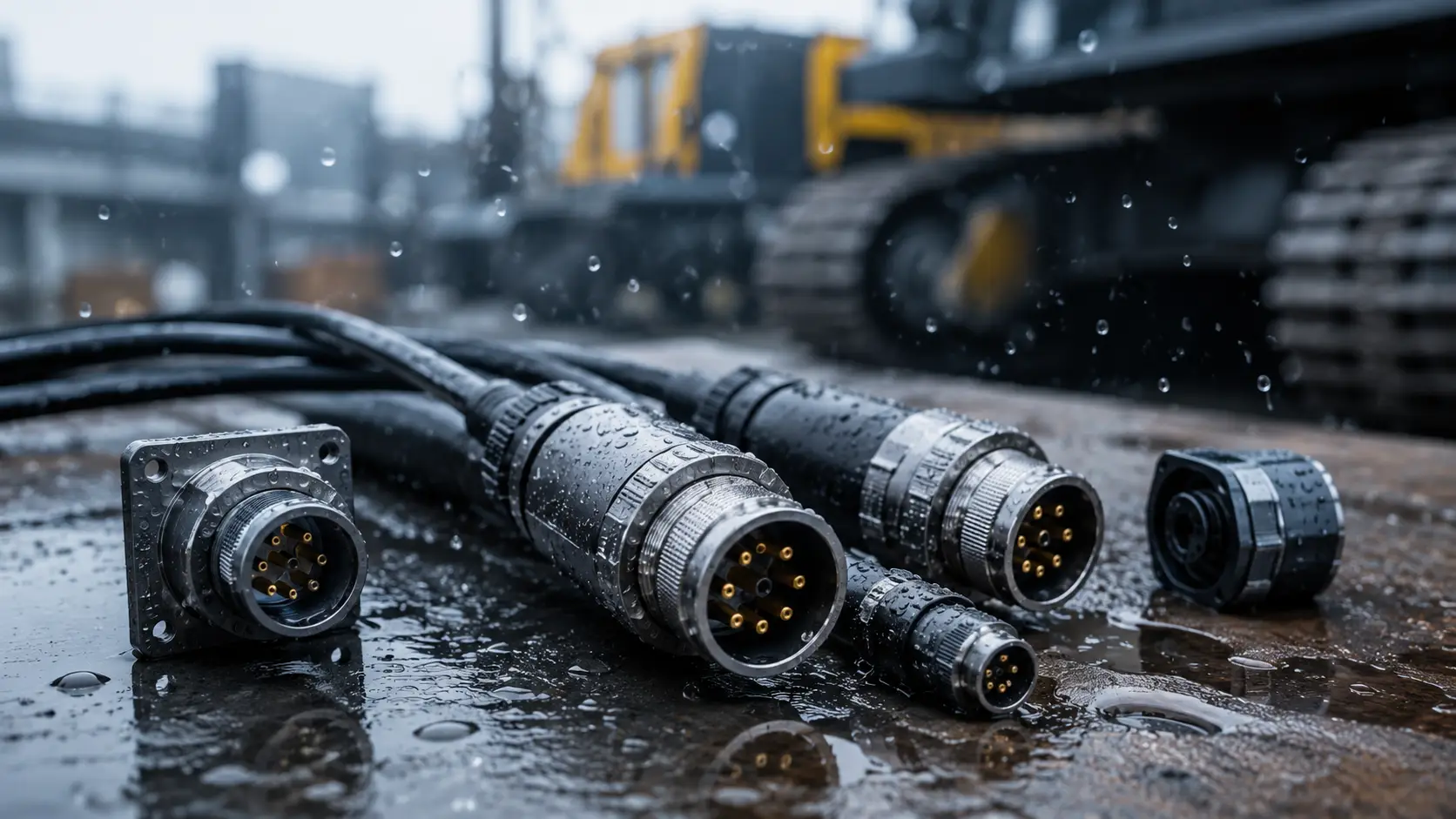
When selecting electrical components, many engineers immediately compare specifications such as current ratings, contact configurations, or mechanical dimensions.
Those specifications are certainly important, but they only tell part of the story.
One factor that is often underestimated during the selection process is environmental protection.
Will the connector be installed inside a climate-controlled control cabinet?
Or will it spend the next fifteen years exposed to rain, salt spray, dust, vibration, chemicals, or frequent washdowns?
The answer to that question often determines whether a system will operate reliably for years — or whether it will require unexpected maintenance after only a short period of operation.
This is exactly why Ingress Protection, better known as IP ratings, has become one of the most important considerations when selecting modern connectors, interconnect solutions, and cable assemblies.
Yet despite their importance, IP ratings are frequently misunderstood.
Many people assume that a higher IP rating automatically means a better product.
In reality, selecting the correct protection level depends entirely on the environment in which the equipment will operate.
Understanding these differences helps engineers design more reliable systems while avoiding unnecessary costs.
What Does an IP Rating Actually Mean?
An IP rating is an internationally recognized classification defined by IEC 60529.
Its purpose is simple:
It indicates how well an enclosure or electrical component protects against the ingress of solid particles and liquids.
The abbreviation stands for:
IP = Ingress Protection
Every IP classification consists of two digits.
For example:
- IP54
- IP65
- IP67
- IP68
- IP69K
Each number represents a different type of protection.
The first digit indicates protection against solid objects such as dust.
The second digit specifies protection against water.
Understanding both numbers is essential when selecting reliable connectivity solutions.
Understanding the First Digit: Protection Against Solids
The first digit ranges from 0 to 6.
The higher the number, the better the protection against particles entering the enclosure.
| First Digit | Protection Level |
|---|---|
| 0 | No protection |
| 1 | Protection against large objects |
| 2 | Fingers and similar objects |
| 3 | Tools and thick wires |
| 4 | Small wires and particles |
| 5 | Dust protected |
| 6 | Dust tight |
For industrial environments, most applications require at least IP65 or higher.
Factories, production lines, and outdoor installations continuously expose equipment to airborne particles that may affect electrical performance.
Choosing the right connector significantly reduces these risks.
Understanding the Second Digit: Protection Against Water
The second digit ranges from 0 to 9K.
This classification is particularly important in industries where equipment is regularly cleaned or exposed to moisture.
| Second Digit | Protection Against Water |
|---|---|
| 0 | No protection |
| 1 | Dripping water |
| 2 | Dripping water at an angle |
| 3 | Spraying water |
| 4 | Splashing water |
| 5 | Water jets |
| 6 | Powerful water jets |
| 7 | Temporary immersion |
| 8 | Continuous immersion |
| 9K | High-pressure, high-temperature washdown |
Although IP67 and IP68 are often mentioned together, they are not interchangeable.
This is one of the most common misconceptions in industrial engineering.
IP67 vs IP68: Which One Should You Choose?
Many purchasing teams automatically select IP68 because they assume "higher is better."
That approach can increase project costs without providing additional value.
Let's compare them.
IP67
An IP67-rated connector provides:
- complete dust protection
- protection during temporary immersion in water
- reliable performance in outdoor environments
- excellent resistance against rain and accidental flooding
Typical applications include:
- industrial automation
- transportation
- machine building
- renewable energy systems
IP68
IP68 offers everything provided by IP67, but with additional protection during continuous immersion.
These products are commonly used in:
- subsea equipment
- marine systems
- underwater monitoring
- offshore installations
Unless continuous immersion is expected, IP68 may not provide practical advantages over IP67.
Selecting the appropriate protection level requires understanding the operating environment rather than simply choosing the highest available specification.
Why Environmental Conditions Matter More Than Specifications Alone
One of the biggest mistakes companies make is selecting components based only on datasheets.
A connector may satisfy every electrical specification while still failing prematurely because environmental factors were overlooked.
Consider the following situations:
Outdoor Renewable Energy Installations
Solar farms and wind turbines expose connectors to:
- UV radiation
- heavy rainfall
- dust
- temperature fluctuations
Electrical performance alone does not guarantee long-term reliability.
Food Processing Facilities
Food production introduces additional challenges.
Equipment is frequently cleaned using:
- high-pressure water
- hot water
- aggressive cleaning chemicals
Here, selecting suitable interconnect solutions becomes essential for maintaining operational continuity.
Offshore Applications
Marine environments introduce:
- salt spray
- humidity
- corrosion
- continuous vibration
Without properly engineered connectivity solutions, corrosion can gradually affect electrical performance long before complete failure becomes visible.
IP Ratings Are Only One Part of the Story
While IP ratings provide valuable information, they should never be the only selection criterion.
Experienced engineers also evaluate:
- operating temperature
- vibration resistance
- corrosion resistance
- EMC performance
- mechanical durability
- mating cycles
- chemical compatibility
- installation requirements
A connector with an excellent IP rating may still be unsuitable if it cannot withstand vibration or repeated mechanical movement.
This is why many organizations combine environmental protection with application-specific engineering support before selecting components.
Looking Beyond the Specification Sheet
Successful projects rarely begin by asking:
"What connector has the highest IP rating?"
Instead, experienced engineers ask:
"What environment will this system operate in over the next ten or twenty years?"
That simple shift in perspective often results in better design decisions, lower maintenance costs, and significantly improved system reliability.
Selecting the correct interconnect solutions is about understanding the complete operating environment — not simply choosing the highest number on a specification sheet.
When Is IP69K Necessary?
One of the fastest-growing search terms within industrial connectivity is IP69K. It is often presented as the highest level of protection available, leading many buyers to assume it is always the best choice.
In reality, IP69K is designed for a very specific purpose.
Unlike IP67 or IP68, which focus on water immersion, IP69K is intended for environments where equipment must withstand high-pressure, high-temperature water jets. During testing, components are exposed to water at temperatures of up to 80°C under high pressure from multiple angles.
This makes IP69K particularly suitable for industries where hygiene is critical and equipment is cleaned several times a day.
Typical applications include:
- food processing facilities
- pharmaceutical production
- beverage manufacturing
- commercial vehicle wash systems
- agricultural machinery exposed to frequent cleaning
For many industrial applications, however, IP69K offers little practical benefit. Selecting it simply because it has the highest rating can increase costs without improving long-term reliability.
The best solution is always the one that matches the actual operating environment.
Real-World Example: When the Wrong IP Rating Becomes Expensive
Imagine a manufacturer of automated packaging machines.
The electrical cabinet is equipped with standard IP54-rated connectors because the equipment operates indoors.
Everything works perfectly during factory acceptance testing.
Six months later, the customer reports intermittent communication failures.
After investigation, engineers discover that the production line is cleaned every evening using high-pressure water.
Although the cabinet itself remains dry, moisture repeatedly reaches the connectors during cleaning.
Small amounts of water gradually enter the connections, leading to corrosion and unreliable communication.
Replacing the connectors requires production downtime, technician visits, replacement parts, and system testing.
The cost of replacing the connectors is relatively small.
The cost of production downtime is not.
A better understanding of IP ratings during the design phase could have prevented the problem entirely.
Common Mistakes When Selecting Connectors for Harsh Environments
Even experienced engineering teams occasionally underestimate environmental influences.
Some of the most common mistakes include:
Assuming Indoor Means Dry
Factories often generate condensation, cleaning moisture, oil mist, or airborne particles that affect electrical connections.
Selecting the Highest IP Rating Without Analysis
Higher isn't automatically better.
The goal is selecting the most appropriate level of protection.
Ignoring Cable Entry Points
A connector may have an excellent IP rating, but an incorrectly installed cable gland or backshell can compromise the entire assembly.
Choosing compatible backshells and properly engineered cable assemblies is just as important as selecting the connector itself.
Focusing Only on Water Protection
Dust, chemicals, UV exposure, vibration, and temperature cycling often create greater long-term challenges than water alone.
Industry-Specific Requirements
Different industries demand different levels of environmental protection.
Rather than asking which IP rating is "best," engineers should ask which rating best supports their application.
Aerospace
Aircraft operate under extreme vibration, pressure changes, and temperature fluctuations.
Reliable connectors must maintain consistent performance while minimizing weight and maximizing durability.
Defense
Military applications often combine harsh environmental exposure with demanding mechanical requirements.
Reliable interconnect solutions must continue operating under shock, dust, moisture, and challenging field conditions.
Industrial Automation
Modern factories depend on uninterrupted communication between machines.
Downtime caused by connector failures can quickly affect an entire production line.
Selecting the right connectivity solutions helps improve long-term operational reliability.
Renewable Energy
Wind turbines and solar installations remain exposed to environmental conditions throughout their service life.
Rain, UV radiation, temperature fluctuations, and airborne contamination all influence connector performance.
Railway and Transportation
Rolling stock experiences continuous vibration together with changing weather conditions.
Reliable cable assemblies and environmental protection become essential for maintaining uninterrupted communication.
A Practical Checklist Before Selecting a Connector
Before making a purchasing decision, engineers should consider the following questions:
✓ Will the equipment operate indoors or outdoors?
✓ Is the connector exposed to rain or direct sunlight?
✓ Will high-pressure cleaning take place?
✓ Is there exposure to chemicals or salt?
✓ Does vibration occur continuously?
✓ Is dust present in the operating environment?
✓ Will maintenance teams disconnect and reconnect the connector regularly?
✓ Is future expansion expected?
The answers provide a much better foundation for selecting suitable interconnect solutions than simply comparing datasheets.
Why Engineering Support Makes a Difference
Choosing the right connector is rarely just about selecting a part number.
Every application has unique requirements.
Cable routing.
Mechanical movement.
Environmental exposure.
Available installation space.
Future maintenance.
Considering all these factors together often leads to a different solution than selecting components based solely on specifications.
This is where experienced engineering support adds real value.
By evaluating the complete application rather than individual components, engineers can identify potential risks before installation begins.
That proactive approach reduces redesigns, minimizes maintenance, and helps systems perform reliably over many years.
Frequently Asked Questions
What does an IP rating mean?
An IP rating indicates how well a connector or enclosure is protected against the ingress of dust and water according to the IEC 60529 standard.
Is IP68 always better than IP67?
No.
IP68 is designed for continuous immersion, while IP67 protects against temporary immersion. For many industrial applications, IP67 provides sufficient protection without additional cost.
When should IP69K be used?
IP69K is recommended for environments where equipment is exposed to high-pressure, high-temperature cleaning, such as food processing or pharmaceutical manufacturing.
Does a higher IP rating improve connector lifespan?
Not necessarily.
Longevity depends on many factors, including vibration, temperature, corrosion, installation quality, and selecting the right connector for the application.
Why should connector selection begin during system design?
Early planning helps engineers evaluate environmental conditions, maintenance requirements, and mechanical constraints before production starts, reducing long-term costs and improving reliability.
Can the wrong connector affect production?
Absolutely.
A connector that isn't designed for its operating environment can lead to corrosion, communication failures, unexpected maintenance, and costly downtime.
Conclusion
Environmental protection is often viewed as just another specification on a datasheet.
In reality, it is one of the most important factors influencing the long-term reliability of modern electronic systems.
Understanding IP ratings allows engineers to make better decisions, avoid unnecessary costs, and design systems that continue performing under real-world conditions — not just inside the laboratory.
Whether a project requires protection against dust, temporary immersion, heavy rainfall, or high-pressure cleaning, selecting the appropriate connectors, backshells, cable assemblies, and interconnect solutions is essential for ensuring dependable performance.
Reliable systems are not built by choosing the highest specification.
They are built by choosing the right solution for the environment.
Ready to Select the Right Connectivity Solution?
Every application presents its own environmental challenges. Choosing the right interconnect solutions early in the design process can prevent costly failures, reduce maintenance, and improve long-term reliability.
Whether you're designing equipment for aerospace, industrial automation, transportation, renewable energy, or another demanding industry, the team at Incotech can help you identify the most suitable connectors, cable assemblies, backshells, and engineering support for your project.
Get in touch with our specialists to discuss your application and find the right solution for your environment.