
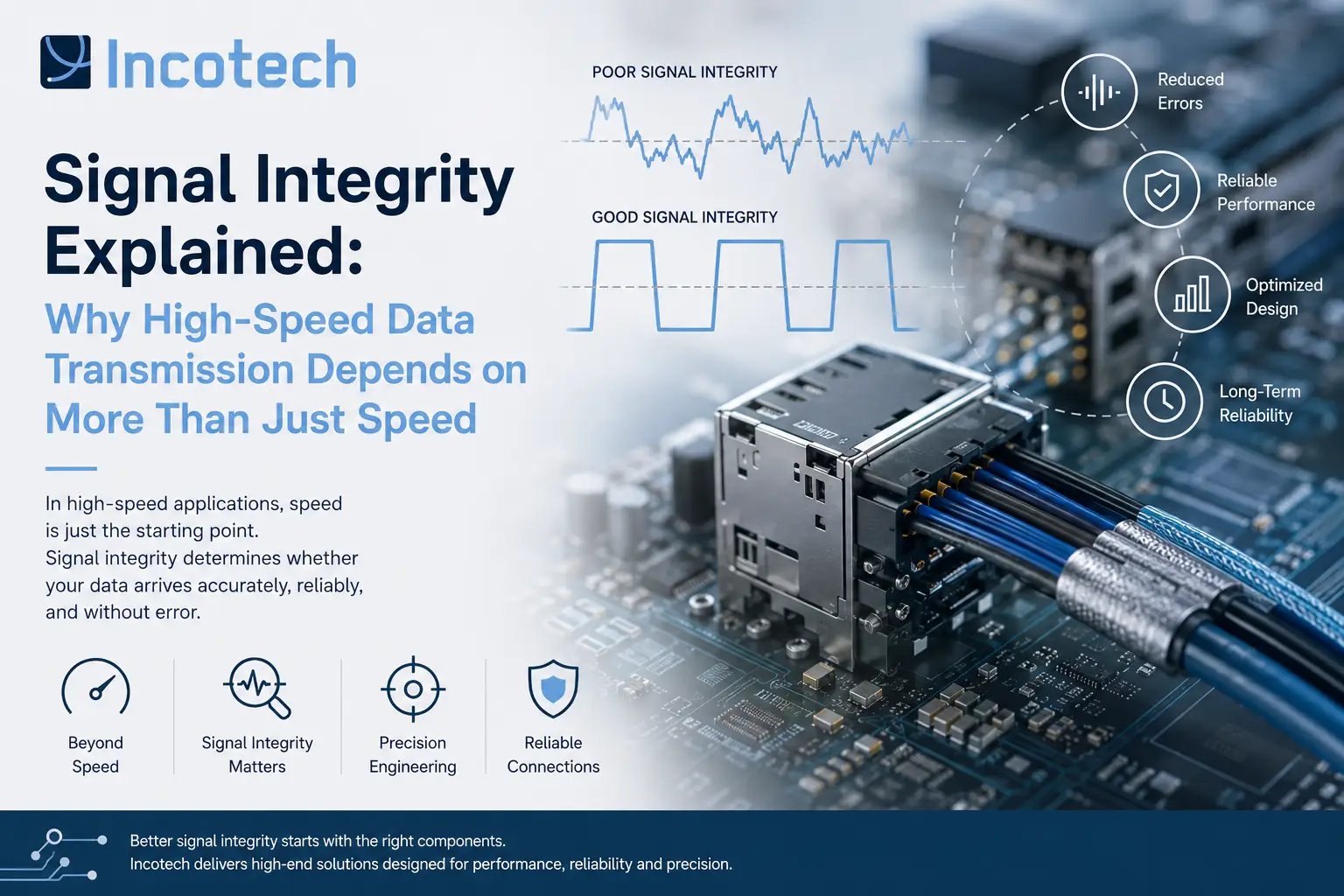
How Signal Integrity Impacts High-Speed Data Transmission in Modern Electronic Systems
For decades, engineers primarily focused on getting signals from point A to point B. If data arrived at its destination, the connection was considered successful.
Today, that is no longer enough.
Modern systems process enormous amounts of data at incredibly high speeds. Autonomous vehicles, industrial robots, aerospace systems, advanced sensors, and intelligent manufacturing equipment all depend on fast and reliable communication between devices.
As transmission speeds continue to increase, a new challenge emerges: maintaining signal quality throughout the entire system.
This challenge is known as signal integrity.
While many organizations focus on processing power and software performance, signal integrity often determines whether a system performs reliably in real-world conditions. Even the most advanced hardware can experience communication issues if signals become distorted before reaching their destination.
For companies operating in high-performance environments, understanding signal integrity is no longer optional—it is essential.
What Is Signal Integrity?
Signal integrity refers to the quality and reliability of an electrical signal as it travels through a system.
In simple terms, the goal is straightforward:
The signal received must accurately match the signal that was transmitted.
However, achieving this becomes increasingly difficult as data rates increase.
A signal can be affected by multiple factors during transmission, including:
- electromagnetic interference
- impedance mismatches
- cable length
- connector quality
- routing complexity
- environmental conditions
- cross-talk between adjacent conductors
When these factors negatively affect a signal, data errors can occur.
In mission-critical applications, even minor signal degradation can have significant consequences.
Why Signal Integrity Matters More Than Ever
A few years ago, many industrial systems operated at relatively low data rates.
Today, industries are rapidly adopting technologies such as:
- Industrial IoT
- AI-driven automation
- edge computing
- machine vision
- autonomous systems
- advanced robotics
All of these technologies require continuous high-speed communication.
The faster data moves, the smaller the margin for error becomes.
A connector that performs perfectly in a low-speed application may create challenges in a high-speed environment.
Similarly, a cable assembly that works well in one application may introduce unwanted signal distortion in another.
This is why modern engineers increasingly evaluate interconnect solutions based on signal performance rather than simply mechanical compatibility.
The Most Common Causes of Signal Integrity Problems
Many signal issues originate from seemingly small design decisions.
Poor Connector Selection
Not all connectors are designed for high-speed applications.
As frequencies increase, connector performance becomes increasingly important.
Poor connector selection can introduce:
- reflection
- insertion loss
- signal attenuation
- impedance discontinuities
Over time, these issues can affect overall system reliability.
Inadequate Cable Design
The quality of a cable assembly directly influences signal transmission.
Factors such as shielding, conductor construction, cable routing, and material selection all affect performance.
A properly engineered custom cable assembly helps preserve signal quality while minimizing interference.
Electromagnetic Interference (EMI)
Electromagnetic interference remains one of the most common challenges in modern electronics.
Industrial environments often contain:
- motors
- power electronics
- switching equipment
- wireless communication systems
These can generate unwanted electromagnetic noise that interferes with signal transmission.
Effective shielding and carefully selected wire and cable solutions help reduce these risks.
Impedance Mismatches
High-speed systems require consistent impedance throughout the signal path.
Even small mismatches between:
- PCB traces
- connectors
- cable assemblies
- electronic components
can create reflections that distort the signal.
Maintaining impedance continuity is a key objective during system design.
Industries Where Signal Integrity Is Critical
Signal integrity affects virtually every modern electronic system, but some industries face particularly demanding requirements.
| Industry | Why Signal Integrity Matters |
|---|---|
| Aerospace | Flight-critical communication systems |
| Defense | Secure and reliable data transmission |
| Robotics | Real-time control and feedback systems |
| Industrial Automation | Continuous machine communication |
| Medical Equipment | Accurate diagnostic and monitoring systems |
| Transportation | Safety-critical data exchange |
In these sectors, communication failures are often unacceptable.
Why Signal Integrity Starts During Design
One of the most common misconceptions is that signal problems can simply be fixed later.
In reality, signal integrity must be considered from the earliest stages of development.
Successful projects often begin with:
- proper system architecture
- careful component selection
- optimized cable routing
- reliable connector design
- early simulation and testing
This is where engineering support becomes particularly valuable.
Addressing potential issues before implementation is almost always less expensive than correcting them later.
How Modern Interconnect Solutions Improve Signal Integrity
Connectivity is no longer just about making electrical connections.
Today's interconnect solutions are engineered to support increasingly demanding performance requirements.
Modern solutions help improve:
Signal Quality
High-performance connectors minimize signal loss and improve transmission consistency.
Noise Immunity
Advanced shielding techniques reduce electromagnetic interference.
Mechanical Reliability
Robust designs maintain performance under vibration, shock, and environmental stress.
Data Throughput
Optimized cable assemblies support higher bandwidth requirements without compromising reliability.
Real-World Example
Imagine an automated production line equipped with high-resolution machine vision cameras.
Each camera continuously transmits large amounts of data to central processing systems.
The system functions perfectly during testing.
However, once installed in the factory environment, intermittent communication errors begin to appear.
After investigation, engineers discover the problem is not software-related.
The root cause is signal degradation caused by inadequate shielding and poorly matched connectivity components.
By upgrading the cable assemblies and implementing properly specified connectors, communication stability is restored.
Situations like this occur far more frequently than many organizations realize.
Frequently Asked Questions
What is signal integrity?
Signal integrity refers to the ability of an electrical signal to travel through a system without distortion or degradation.
Why is signal integrity important?
Poor signal integrity can cause communication errors, reduced performance, system instability, and data corruption.
What affects signal integrity?
Factors such as connector quality, cable design, electromagnetic interference, impedance mismatches, and routing practices all influence signal integrity.
Can cable assemblies improve signal integrity?
Yes. Properly designed custom cable assemblies help reduce interference, maintain impedance consistency, and improve overall transmission quality.
Are signal integrity issues only relevant to high-speed systems?
While they become more critical at higher data rates, signal integrity affects virtually all electronic systems to some degree.
How can companies reduce signal integrity risks?
Early planning, proper component selection, testing, and professional engineering support significantly reduce the likelihood of signal-related problems.
The Future of Connectivity Depends on Signal Integrity
As industries continue to embrace automation, AI, machine vision, and connected technologies, the demand for reliable data transmission will only increase.
Processing power will continue to grow.
Bandwidth requirements will continue to expand.
Systems will become more interconnected than ever before.
Yet none of these advancements can deliver their full potential without reliable communication between components.
That is why signal integrity is rapidly becoming one of the most important considerations in modern system design.
Organizations that invest in high-quality interconnect solutions, carefully engineered cable assemblies, reliable connectors, and expert engineering support position themselves for greater reliability, better performance, and long-term success.
Strong Call-To-Action
Experiencing challenges with signal quality, data transmission, or connectivity performance? Our team can help evaluate your application and recommend the right interconnect solutions, connectors, and cable assemblies to support reliable high-speed communication. Contact Incotech to discuss your project requirements.