
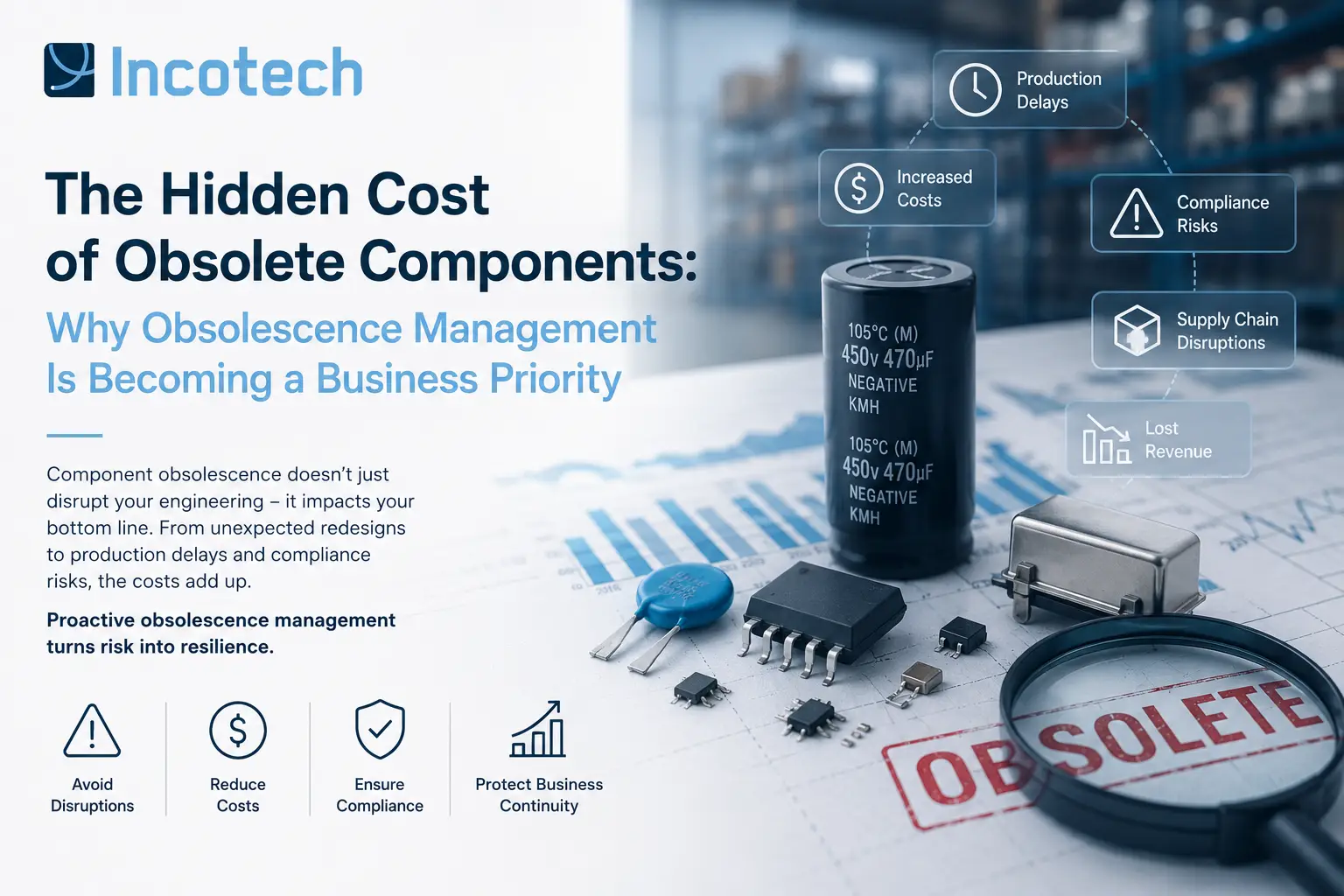
Most companies focus on innovation. New technologies, faster systems, smarter automation, and increasingly powerful electronics dominate conversations about the future.
Yet one of the biggest challenges facing high-tech industries today has little to do with new technology.
It has to do with old technology.
Across industries such as aerospace, defense, transportation, industrial automation, and critical infrastructure, organizations are facing a growing problem: essential components are disappearing from the market faster than ever before.
A connector that was available five years ago may no longer be in production. A specific cable assembly used in a certified system might suddenly become difficult to source. Manufacturers discontinue products, standards evolve, and supply chains change.
The result is a challenge known as component obsolescence.
And for many organizations, it is becoming one of the most expensive risks they face.
Why Obsolescence Is Accelerating
In the past, many industrial systems remained largely unchanged for decades.
Today, technology moves much faster.
Manufacturers continuously introduce new products while phasing out older ones. At the same time, industries are becoming increasingly dependent on specialized electronics and advanced interconnect solutions.
Several factors are accelerating obsolescence:
- shorter product life cycles
- increasing technological complexity
- mergers and acquisitions among manufacturers
- changing industry standards
- growing regulatory requirements
- global supply chain disruptions
For companies managing long-life systems, this creates significant uncertainty.
A system may have been designed to operate for twenty years, while some of its components remain available for only a fraction of that time.
The Real Cost Is Often Hidden
Many organizations only discover obsolescence when they need a replacement part.
By that stage, the problem has already become expensive.
When critical components become unavailable, businesses often face:
- emergency sourcing efforts
- unexpected engineering costs
- project delays
- recertification requirements
- redesign expenses
- increased operational risks
In highly regulated industries, replacing a component is not always straightforward. Even seemingly small changes may require additional testing, validation, or approval processes.
The true cost of obsolescence often extends far beyond the price of the component itself.
Why Connectors and Cable Assemblies Are Particularly Vulnerable
While electronic components often receive the most attention, connectivity infrastructure can create equally significant challenges.
Many systems rely on specific:
These components are frequently selected based on strict environmental, mechanical, or certification requirements.
Finding an exact replacement years later may not always be possible.
This is especially true in industries where reliability, compatibility, and compliance are critical.
A discontinued connector can affect an entire assembly.
A single unavailable cable specification can impact a complete project.
The Companies That Handle Obsolescence Best Start Early
One common misconception is that obsolescence can be managed when it happens.
The reality is that successful organizations take a proactive approach.
Instead of reacting to shortages, they continuously evaluate the lifecycle status of critical components.
This allows them to:
- identify future risks
- plan replacements in advance
- avoid emergency redesigns
- secure long-term availability
- improve budget predictability
In many cases, the goal is not simply finding alternative products.
The goal is ensuring operational continuity.
A Strategic Approach to Long-Term System Reliability
Effective obsolescence management typically combines several strategies.
Lifecycle Monitoring
Organizations continuously track the status of critical components and monitor manufacturer announcements.
Strategic Inventory Planning
Certain components may require long-term stocking strategies to support future maintenance requirements.
Alternative Qualification
Potential replacement solutions are evaluated before they become necessary.
Technical Evaluation
Expert engineering support helps assess compatibility and performance implications when changes become unavoidable.
Supply Chain Collaboration
Working closely with specialized suppliers improves visibility into future availability and sourcing risks.
Frequently Asked Questions
What is component obsolescence?
Component obsolescence occurs when a product is no longer manufactured, supported, or readily available, making maintenance and future production more difficult.
Why is obsolescence management important?
Without proper planning, obsolete components can lead to downtime, redesign costs, project delays, and increased operational risks.
Which industries are most affected?
Industries with long product lifecycles, such as aerospace, defense, transportation, industrial automation, and critical infrastructure, are particularly vulnerable.
Are connectors and cable assemblies affected by obsolescence?
Yes. Many specialized connectors, cable assemblies, and interconnect solutions eventually reach end-of-life status, creating sourcing challenges.
Can obsolescence be prevented?
Not entirely. However, proactive planning, lifecycle monitoring, and strategic sourcing can significantly reduce its impact.
How does engineering support help?
Engineering support helps organizations evaluate alternatives, maintain compatibility, and reduce the risks associated with component replacement.
Looking Beyond Today's Requirements
Technology will continue to evolve.
Products will continue to be introduced, replaced, and discontinued.
The companies that succeed in the long term are not necessarily those with access to the newest technologies. They are often the organizations that plan effectively for the realities of technological change.
By taking a proactive approach to supply chain management, engineering support, and interconnect solutions, businesses can reduce risk, improve continuity, and protect critical systems throughout their entire lifecycle.
Because in many industries, future success is not just about what comes next.
It is also about ensuring what already works continues to work for years to come.