
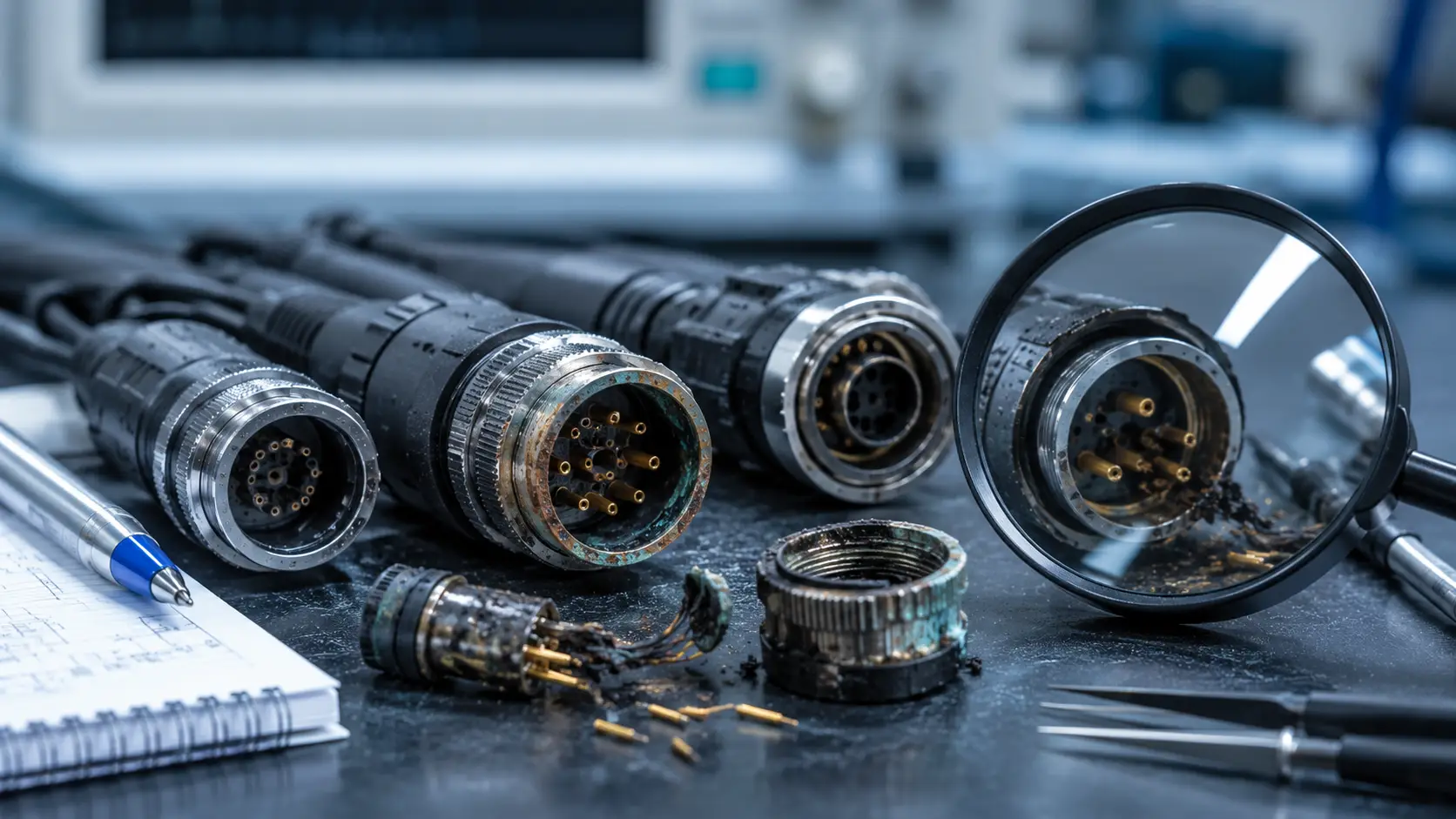
When an electrical system suddenly stops working, many people immediately suspect the software, power supply, or control electronics.
Surprisingly often, the actual cause is much simpler.
A connector.
Although connectors represent only a small fraction of the total system cost, they are responsible for maintaining every electrical signal and power connection throughout the system. If one connection becomes unreliable, the entire system can be affected.
In industries such as aerospace, defense, industrial automation, transportation, robotics, and offshore engineering, connector failures can lead to production downtime, expensive troubleshooting, delayed projects, or even safety risks.
The good news?
Most connector failures are preventable.
Understanding why connectors fail is the first step toward designing systems that continue to perform reliably for years.
Why Connector Failures Are Becoming More Common
Modern electronic systems are evolving rapidly.
Equipment is becoming:
- smaller
- faster
- more powerful
- increasingly connected
At the same time, operating environments are becoming more demanding.
Connectors are now expected to withstand:
- constant vibration
- extreme temperatures
- moisture
- dust
- chemicals
- high-speed data transmission
- frequent mating cycles
As these requirements increase, selecting the right Connectors, Cable Assemblies, and Interconnect Solutions becomes more important than ever.
Many failures are not caused by poor-quality products but by selecting the wrong solution for the application.
The 10 Most Common Causes of Connector Failure
1. Corrosion
Corrosion remains one of the leading causes of connector failure worldwide.
Moisture, humidity, salt spray, industrial chemicals, and airborne contaminants gradually attack metallic contact surfaces.
As corrosion develops, electrical resistance increases.
Eventually, communication becomes unreliable or stops completely.
Applications particularly exposed to corrosion include:
- offshore installations
- railway systems
- renewable energy
- marine equipment
- outdoor automation
Selecting corrosion-resistant Connectors and suitable Backshells can significantly increase system lifespan.
2. Vibration and Mechanical Shock
In many industrial applications, connectors experience continuous movement.
Examples include:
- heavy machinery
- aircraft
- military vehicles
- industrial robots
- transportation systems
Over time, vibration can loosen contacts or create microscopic movement between mating surfaces.
This phenomenon, often referred to as fretting, gradually damages contact surfaces.
The result is intermittent communication that becomes increasingly difficult to diagnose.
Choosing rugged Interconnect Solutions specifically designed for high-vibration environments greatly reduces this risk.
3. Incorrect Connector Selection
Not every connector is suitable for every environment.
Unfortunately, connector selection is sometimes based primarily on price or availability.
Important factors such as:
- IP rating
- operating temperature
- vibration resistance
- EMC performance
- current rating
- mating cycles
may receive less attention than they deserve.
The wrong connector may function perfectly during testing but begin failing after months of real-world operation.
This is one reason why early Engineering Support often saves considerable costs later in the project.
4. Poor Crimp Quality
Many connector failures originate long before installation.
Incorrect crimping remains one of the most common assembly errors.
Poor crimps may cause:
- increased resistance
- overheating
- intermittent connections
- mechanical weakness
Using the correct tooling, validated processes, and properly manufactured Cable Assemblies dramatically improves long-term reliability.
5. Contamination
Dust, oil, grease, metal particles, and moisture all affect connector performance.
Even microscopic contamination can reduce contact quality.
Industrial production environments often expose electrical systems to far more contamination than originally anticipated.
Proper sealing, environmental protection, and suitable IP-rated Connectors help minimize these risks.
6. Overheating
Heat is one of the most underestimated causes of connector failure.
Unlike corrosion or physical damage, overheating often develops gradually. Everything may appear to function normally until excessive temperatures begin degrading insulation materials, weakening contacts, or increasing electrical resistance.
Several factors can contribute to overheating:
- connectors carrying more current than they were designed for
- poor contact quality
- loose terminations
- inadequate ventilation
- high ambient temperatures
- repeated thermal cycling
One important point to remember is that heat creates a vicious circle. As contact resistance increases, more heat is generated. More heat further increases resistance, accelerating the failure process.
Selecting properly rated Connectors and professionally designed Cable Assemblies helps prevent these issues before they occur.
7. Electromagnetic Interference (EMI)
Industrial environments are filled with sources of electromagnetic noise.
Variable frequency drives, electric motors, switching power supplies, radio systems, and heavy electrical equipment all generate electromagnetic interference.
When connectors and cables are not properly protected, this interference can affect signal quality and data transmission.
Typical symptoms include:
- intermittent communication errors
- corrupted data
- unstable sensor readings
- unexpected system resets
In many cases, engineers initially suspect software problems while the real cause lies within the physical connection.
Using properly shielded Cable Assemblies, suitable Backshells, and high-quality Interconnect Solutions significantly reduces the effects of EMI.
8. Excessive Mating Cycles
Every connector has a specified mating cycle rating.
This indicates how many times it can be connected and disconnected while maintaining reliable electrical performance.
For some applications this may be a few hundred cycles.
For others, it may exceed several thousand.
Problems arise when connectors designed for occasional use are repeatedly disconnected during maintenance or testing.
Over time, repeated mating causes:
- contact wear
- reduced contact pressure
- increased resistance
- unreliable communication
Selecting connectors based on expected maintenance frequency is often overlooked during system design.
9. Incorrect Installation
Even the highest-quality connector can fail if it is installed incorrectly.
Common installation mistakes include:
- excessive cable bending
- improper torque
- insufficient strain relief
- damaged seals
- incorrect pin alignment
Many of these issues do not cause immediate failures.
Instead, they gradually reduce reliability until problems appear months or even years later.
Proper installation procedures, together with suitable Engineering Support, can eliminate many of these risks before equipment enters service.
10. Lack of Preventive Maintenance
Not every connector requires regular maintenance.
However, systems operating in harsh environments benefit greatly from periodic inspection.
A simple maintenance routine can identify:
- early corrosion
- loose locking mechanisms
- damaged seals
- worn contacts
- contamination
- mechanical damage
Replacing a connector during scheduled maintenance is almost always less expensive than dealing with unexpected downtime.
Warning Signs That a Connector May Be Failing
Connector failures rarely happen without warning.
In many cases, the system provides subtle indications long before complete failure occurs.
Watch for symptoms such as:
- intermittent communication
- unexpected equipment resets
- increased operating temperature
- visible discoloration
- corrosion around contacts
- inconsistent sensor signals
- connectors becoming difficult to mate
- physical damage to locking mechanisms
Ignoring these warning signs often results in more extensive repairs later.
Case Study
A Minor Connector Problem That Shut Down an Entire Production Line
A manufacturer of automated packaging equipment experienced random communication faults affecting several robotic workstations.
Initially, engineers investigated the PLC software, network switches, and control systems.
Everything appeared to function correctly.
After several days of troubleshooting, the root cause was identified.
One connector located near a high-vibration motor had developed microscopic contact wear due to continuous movement.
Although the connector still appeared to be fully engaged, intermittent signal interruptions occurred under vibration.
Replacing the connector with a more suitable vibration-resistant solution eliminated the issue immediately.
The replacement itself took less than thirty minutes.
The production downtime had already cost several thousand euros.
Best Practices for Preventing Connector Failures
Companies achieving the highest levels of reliability generally follow the same principles.
✔ Select connectors based on the actual operating environment.
✔ Consider vibration, moisture, temperature, chemicals, and maintenance requirements during design.
✔ Use professionally manufactured Cable Assemblies.
✔ Select compatible Backshells and strain relief solutions.
✔ Verify connector specifications rather than selecting purely on price.
✔ Perform regular inspections in harsh environments.
✔ Involve experienced Engineering Support during system development.
Small decisions made early often prevent major problems later.
Conclusion
Electrical connector failures are rarely random.
Most failures can be traced back to environmental conditions, incorrect product selection, installation mistakes, or insufficient planning.
As electronic systems continue to become more advanced, the importance of reliable connectivity will only increase.
Every connector forms part of a much larger system.
When one connection fails, the consequences can extend far beyond a single component.
By investing in high-quality Connectors, professionally designed Cable Assemblies, reliable Backshells, and expert Engineering Support, organizations can significantly improve reliability, reduce maintenance costs, and increase the operational lifespan of critical equipment.
Reliable systems begin with reliable connections.
Frequently Asked Questions
What is the most common cause of connector failure?
There is no single cause, but corrosion, vibration, improper connector selection, poor crimping, and environmental contamination are among the most common reasons electrical connectors fail. Many failures can be prevented by selecting the correct Connectors and considering the operating environment during the design phase.
How can connector failures be prevented?
The best approach combines several factors:
- selecting the correct connector for the application
- using professionally manufactured Cable Assemblies
- protecting connections against moisture and contamination
- ensuring proper installation
- performing periodic inspections
- involving experienced Engineering Support early in the project
Preventive planning is almost always less expensive than corrective maintenance.
Why do connectors fail in high-vibration environments?
Continuous vibration causes microscopic movement between contact surfaces. Over time, this can lead to fretting corrosion, increased contact resistance, and intermittent electrical connections.
Selecting vibration-resistant Interconnect Solutions significantly reduces this risk.
Does connector quality really make a difference?
Absolutely.
High-quality connectors are designed with better contact materials, tighter manufacturing tolerances, improved sealing, and more durable locking mechanisms.
While the initial investment may be higher, they often reduce maintenance costs and improve long-term reliability.
Should connector selection start during system design?
Yes.
Many connector-related problems originate during the design phase rather than during production.
Considering environmental conditions, maintenance requirements, available space, mechanical loads, and electrical performance early in the project allows engineers to make better decisions before systems are built.
How often should connectors be inspected?
The inspection interval depends on the operating environment.
Applications exposed to vibration, moisture, chemicals, or outdoor conditions generally benefit from regular inspections during scheduled maintenance.
Early detection of wear or corrosion can prevent unexpected system failures.
Are custom cable assemblies more reliable than standard solutions?
In many applications, yes.
Custom Cable Assemblies are designed specifically for the operating environment and system requirements. This improves installation quality, reduces mechanical stress, minimizes routing issues, and often increases long-term reliability.
Final Thoughts
Electrical connectors rarely receive much attention when a new system is designed.
Yet they are responsible for something every modern application depends on: reliable communication.
Whether transmitting power, data, or control signals, every connection must continue performing under real-world operating conditions — not only during laboratory testing.
As systems become smaller, faster, and more connected, the demands placed on connectors continue to increase.
Successful projects are no longer built by selecting components individually.
They are built by understanding how every connector, cable assembly, backshell, and interface contributes to the overall reliability of the system.
Organizations that invest in carefully selected Interconnect Solutions, high-quality Connectors, professionally engineered Cable Assemblies, and expert Engineering Support are investing in fewer failures, lower maintenance costs, and greater operational confidence.
Because in mission-critical applications, reliability is never the result of luck.
It is engineered from the very first connection.
Ready to Improve Connector Reliability?
Whether you're developing a new system or improving an existing design, selecting the right connectivity solution can prevent costly failures before they occur.
At Incotech, we help engineers and purchasing professionals identify the most suitable Connectors, Cable Assemblies, Backshells, and Engineering Support for demanding applications across aerospace, defense, industrial automation, transportation, offshore, and many other industries.
Contact our specialists today and discover how the right interconnect solution can improve the reliability of your next project.