
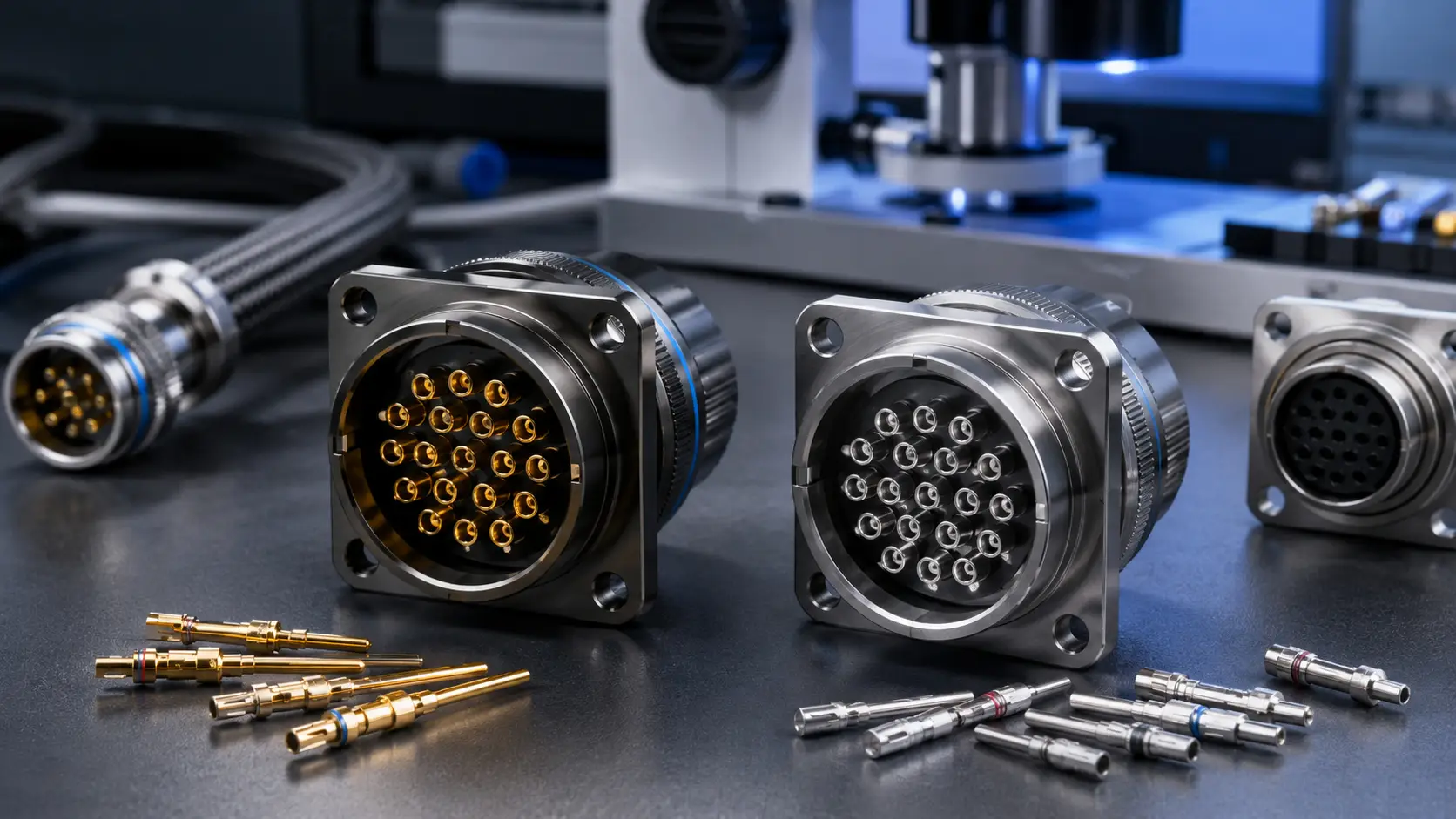
Two connectors can look almost identical on the outside and behave very differently after years in service.
The reason may be only a few microns thick.
Contact plating.
When choosing a connector, engineers naturally focus on pin count, current rating, dimensions, sealing and mechanical compatibility. The finish on the contacts is easier to overlook, yet it directly affects contact resistance, corrosion behaviour, mating durability and ultimately the reliability of the connection.
Gold and tin are two of the most common choices. Neither is automatically better.
The right answer depends on where the connector will be used, what signals it carries and what will happen to it during its lifetime.
What Does Contact Plating Actually Do?
The conductive contact inside a connector is normally made from a base material selected for its mechanical and electrical properties. A thin metallic finish is then applied to the contact surface.
That finish is the part that actually meets the corresponding pin or socket. It is not the same thing as the coating on the wire strands behind it, which is chosen for temperature and shelf life rather than for contact resistance.
Its job is not simply to make the contact look different. It helps control:
-
electrical contact resistance;
-
corrosion and oxidation;
-
wear during mating and unmating;
-
friction between contacts;
-
long-term connection stability.
This is why contact finish should be considered when selecting high-performance Connectors, particularly for systems expected to remain in service for many years.
Why Gold Is Used in High-Reliability Connectors
Gold has one major advantage in electrical contacts: it does not readily form an insulating oxide layer under normal operating conditions.
That makes the electrical interface extremely stable.
For low-voltage and low-current signals, this is particularly valuable. There may not be enough electrical or mechanical energy at the contact interface to overcome contamination or a resistive oxide layer.
Gold avoids much of that problem.
It is therefore commonly found in applications where consistent signal performance is more important than minimizing component cost.
Think of:
-
aerospace electronics;
-
defence communication systems;
-
instrumentation;
-
data connections;
-
sensor circuits;
-
high-reliability industrial electronics.
Gold also performs well where a connector is expected to be disconnected and reconnected repeatedly.
For applications that demand this level of contact performance, products such as Incotech's gold-plated D-Sub pin contact and gold-plated D-Sub socket contact illustrate how contact finish becomes part of the overall connector specification.
The downside?
Cost.
Gold is considerably more expensive than tin. Using it where the application does not actually require its properties can increase component cost without creating a meaningful reliability benefit.
That brings us to tin.
Why Tin Is Still Used So Widely
If gold performs so well, why aren't all connector contacts gold-plated?
Because many applications simply don't need it.
Tin is considerably more economical and offers good electrical performance when used in the right connector design.
It is particularly attractive in applications with relatively few mating cycles and where sufficient contact force is available.
Unlike gold, however, tin reacts with the surrounding atmosphere and develops an oxide film on its surface.
That sounds problematic, but a properly designed tin contact compensates for it.
As the contacts mate, adequate normal force and wiping action help break through the oxide layer and create the required conductive interface.
For many industrial and cost-sensitive applications, that is entirely sufficient.
Tin also offers excellent solderability, which is one reason it remains so common throughout the electronics industry.
Gold vs Tin at a Glance
The difference becomes easier to understand when you stop asking which material is better? and instead ask which material fits this application?
Choose gold when:
-
signal levels are very low;
-
long-term contact stability is critical;
-
connectors will experience repeated mating cycles;
-
equipment operates in demanding environments;
-
very low and stable contact resistance is important;
-
failure would carry a high operational cost.
Consider tin when:
-
cost sensitivity is important;
-
mating cycles are limited;
-
the connector design provides sufficient contact force;
-
the operating environment is relatively controlled;
-
the application does not require extremely low-level signal performance.
There are exceptions, of course. Connector design is always a system-level decision rather than a single-material choice.
A Connector That Is Never Unplugged Is a Different Challenge
Mating cycles are one of the easiest requirements to overlook.
Imagine two systems.
The first connector is installed inside a machine during production and may remain connected for ten years.
The second sits on test equipment and is disconnected several times per week.
Electrically, the connectors might perform the same function.
Mechanically, their lives could not be more different.
Every mating cycle creates friction between the contact surfaces. Over time, that friction wears the finish.
Where repeated connection and disconnection are expected, gold is generally better suited to maintaining a stable contact interface.
For a connection that is assembled once and left untouched in a relatively benign environment, tin may provide all the performance required at a lower cost.
This is exactly why looking at the complete application before choosing Interconnect Solutions matters.
Environment Changes the Decision
A connector never operates in isolation.
Temperature, humidity, vibration and contaminants all affect the contact interface.
In a clean electronic enclosure, contact conditions may remain relatively stable for years.
Place that same connector in an aircraft, military vehicle, industrial machine or offshore installation and the situation changes.
Small movements caused by vibration can create microscopic wear at the contact interface. Combined with oxidation or contamination, that can increase contact resistance and eventually produce intermittent faults.
Gold's resistance to oxidation makes it particularly valuable where electrical reliability must be maintained despite these environmental stresses.
But the finish is only part of the solution.
The connector body, sealing, backshell, cable termination and strain relief must all work together. Selecting the right connectors en backshells as one system is therefore considerably more effective than evaluating each component independently.
One Important Rule: Be Careful Mixing Gold and Tin
An easy mistake is to replace one half of a connector pair without checking the contact finish on the mating component.
For example:
gold pin + tin socket
It may physically fit.
It may even work perfectly during the first tests.
That doesn't automatically make it a good long-term combination.
Dissimilar contact finishes can behave differently under vibration, humidity and repeated micro-movement. For high-reliability applications, the mating surfaces should therefore be selected and qualified as a complete contact system rather than chosen independently.
As a practical principle:
gold-to-gold and tin-to-tin are preferable to an unqualified mixed interface.
This becomes especially important when replacing obsolete components or finding alternatives for existing systems.
A substitute connector isn't truly equivalent simply because the dimensions and pin layout match.
What About Selective Gold Plating?
There is another clever solution that combines the strengths of both materials.
Selective plating.
Instead of applying an expensive gold finish over the entire contact, gold can be used only where the two contacts actually mate.
A different finish, often tin, can then be used elsewhere on the contact where properties such as solderability matter more.
This allows connector manufacturers to put the premium material exactly where it creates value.
For engineers and purchasing teams, it is a useful reminder that the words gold plated alone don't tell the complete story.
Where the gold is applied and how much is applied can matter just as much.
Not All Gold-Plated Contacts Are the Same
Seeing "gold plated" on a datasheet can create a false sense of certainty.
Plating thickness matters.
A very thin gold flash is not necessarily intended for the same operating conditions as a more substantial gold finish designed for high durability.
Other factors matter too:
-
contact geometry;
-
underplating;
-
normal force;
-
base material;
-
environmental sealing;
-
expected mating cycles.
So don't select a contact based solely on the name of the finish.
Look at the complete specification.
This is particularly important when sourcing replacement crimp contacts and adapters or connector components for aerospace and defence systems, where seemingly small differences can affect qualification and long-term reliability.
Cost vs Reliability: Avoid Both Underdesign and Overdesign
Engineering often involves balancing two expensive mistakes.
The first is underdesign.
Choosing a lower-cost contact finish for a harsh, high-cycle or low-level signal application can save a small amount on the connector but create a much larger maintenance problem later.
The second is overdesign.
Specifying premium gold contacts everywhere, including connections that are mated once and operate in controlled conditions, may increase costs without significantly improving the system.
The goal isn't to specify the most expensive connector.
It is to specify the connector that delivers the required reliability throughout the intended service life.
A Practical Selection Checklist
Before choosing between gold and tin contacts, ask:
What is being transmitted?
Low-level analogue signals and sensitive data may demand different contact performance than relatively robust power circuits.
How often will the connector be mated?
A service connector may experience far more wear than a permanent internal connection.
What environment will it operate in?
Humidity, vibration, contamination and temperature can all influence long-term performance.
What happens if the connection becomes unreliable?
The acceptable risk for consumer equipment is very different from that of an aerospace or defence system.
What is on the mating side?
Always consider the pin and socket as one electrical interface.
Is the proposed alternative truly equivalent?
Dimensions alone are not enough. Contact finish, material, specification and qualification should also be checked.
Frequently Asked Questions
Is gold always better than tin for connector contacts?
No. Gold offers excellent stability and durability, but tin can be the more appropriate and economical option for low-cycle applications operating under suitable conditions. The correct choice depends on the complete application.
Why are gold contacts used for low-level signals?
Gold does not readily form an insulating oxide layer, helping maintain a stable, low-resistance contact interface when voltage and current levels are very small.
Can gold-plated contacts wear out?
Yes. Gold plating is highly suitable for repeated mating, but it is still a physical surface that can wear. Contact design, plating thickness, normal force and mating cycles all affect lifetime.
Can a gold-plated connector be mated with a tin-plated connector?
It may function initially, but combining dissimilar contact finishes can introduce long-term reliability risks. For demanding applications, the complete mating interface should be properly evaluated and qualified.
Does thicker gold automatically mean a better connector?
Not necessarily. More plating may improve durability in some applications, but the correct thickness depends on the contact design and operating requirements. More material can simply mean more cost if the application does not need it.
The Smallest Detail Can Decide the Reliability of the Entire Connection
Contact plating is easy to overlook because you rarely see it once the connector is installed.
But electrically, it sits at one of the most important interfaces in the entire system.
Gold provides outstanding stability where reliability, low-level signals and repeated mating matter. Tin provides a practical and economical solution where the connector design and operating conditions allow it.
Neither should be selected by habit.
The best connector is the one whose electrical, mechanical and environmental characteristics match the application as a complete system.
When that decision becomes more complex, Incotech can support the selection of Connectors, contacts, accessories and complete interconnect solutions for demanding industrial, aerospace and defence applications.