
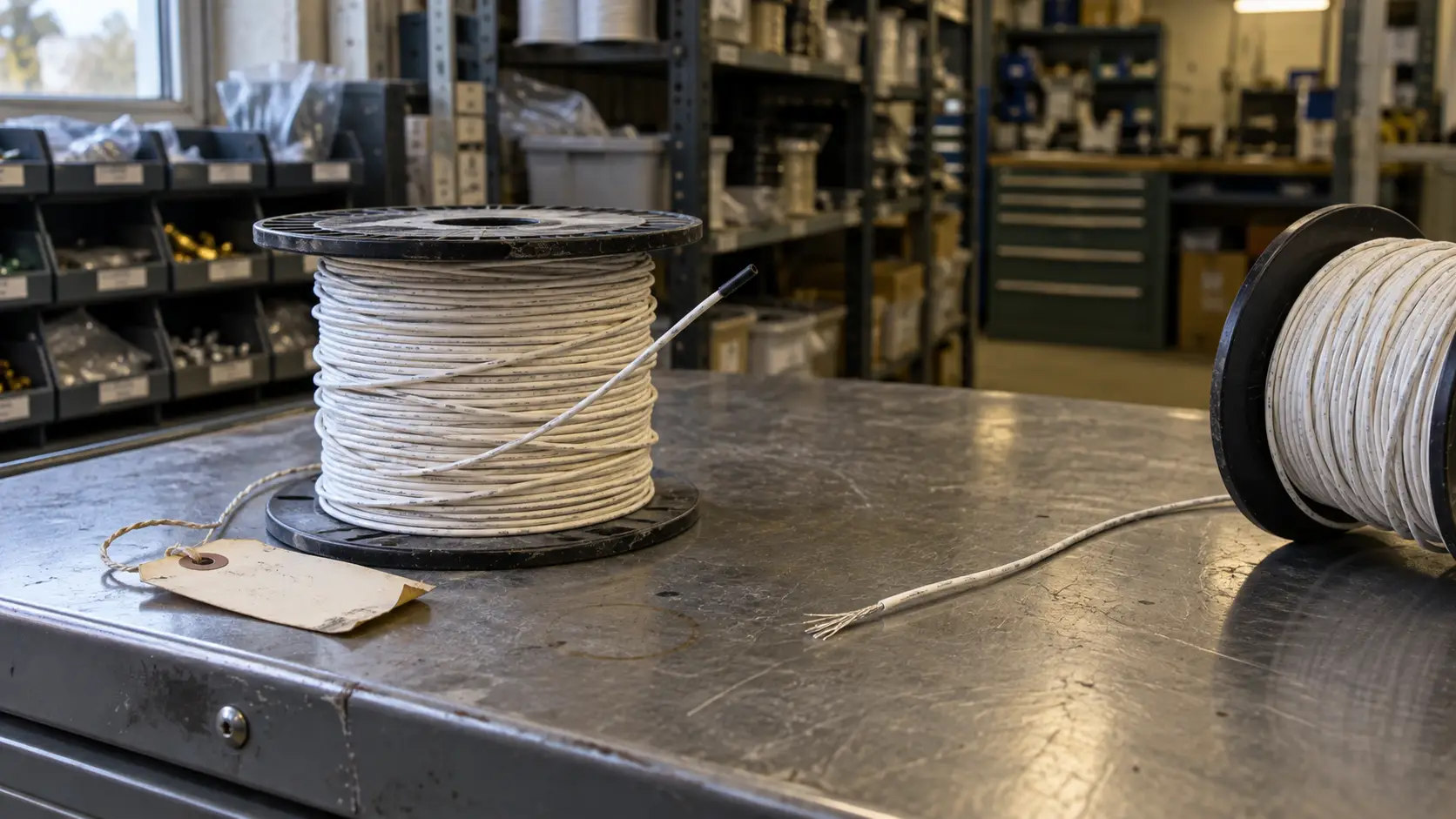
M22759/16-20-9 and M22759/44-20-9 sit next to each other on a bill of materials and look like near neighbours. Same gauge, same colour field, one field apart. One is rated to 150 °C and needs no special storage regime. The other is rated to 200 °C and carries a corrosion-control discipline that quietly fails in most stockrooms.
Among aerospace wire and cable families, the M22759 wire specification is the most commonly stocked in Europe, and the part number on the drum tells you more than most buyers read out of it. Four fields, and the middle one does almost all the work. Get it wrong and the wire either cooks, corrodes on the shelf, or costs three times what the application needed.
How Do You Read an M22759 Part Number?
An M22759 part number has four fields: the base specification, the slash sheet number, the conductor size in AWG, and a colour designator. The slash sheet does the real work. It fixes the insulation system, the conductor coating and the temperature rating in a single two-digit number, and nothing else in the part number can override it.
So M22759/44-28-9 is a 28 AWG wire built to slash sheet 44, and that 44 is the field worth arguing about.
The Specification Moved and the Part Marking Did Not
Engineers still write MIL-W-22759 on drawings and still call the wire M-spec. The governing document is the SAE one. SAE AS22759E, revised on 15 July 2024 by the AE-8D Wire and Cable Committee, covers fluoropolymer-insulated single conductor wires made with tin-coated, silver-coated or nickel-coated conductors of copper or copper alloy, with PTFE, FEP, PVF2 and ETFE among the insulation options. QPL-22759-46, dated 12 April 2022, is issued against that SAE number and maintained by Naval Air Systems Command at Patuxent River.
None of which changes the part marking. Your drum will still read M22759. Treat the M prefix as a legacy label on a live SAE specification, and check the slash sheet against the current QPL rather than against a photocopy of a 1990s drawing.
Tin, Silver, Nickel: What the Coating Is Actually For
The coating on the strands is not there for conductivity. Copper conducts better than any of the three. It is there to stop the copper reacting with its insulation and its environment at temperature, and to keep the strand surface solderable and crimpable after years on a shelf. Tin is cheap and easy to terminate. Nickel survives the most heat and is the least pleasant to work with, hard enough on crimp dies to belong in the same conversation as your tooling and positioner selection. Silver sits between them and brings a problem the other two do not have.
Worth separating this from a decision the series has already covered. Conductor coating is the plating on the wire strands. Contact plating is the finish on the pin or socket the wire is crimped into, and the gold and tin trade-off at the contact interface runs on completely different logic. Two different interfaces, two different failure modes, and engineers routinely conflate them in specification reviews.
The Temperature Ceiling Is Not Set by the Coating Alone
This is the part most people get wrong, and the QPL settles it in one reading. Silver-coated wire is widely described as 200 °C wire. Read the slash sheet titles in QPL-22759-46 and silver-coated conductors appear at both 150 °C and 200 °C, depending entirely on what is extruded over them.
Slash sheet 17 is extruded ETFE over silver-coated high strength copper alloy, rated 150 °C. Move to slash sheet 44, crosslinked modified ETFE over silver-coated copper, and the rating is 200 °C. Same coating. Fifty degrees apart.
Coating sets a floor on what the conductor can tolerate. What is extruded over it sets the ceiling the assembly is actually qualified to. Specify a coating, assume a temperature, and you will eventually order a 150 °C wire for a 180 °C run; the first sign will be insulation shrinkback at a clamp six months in.
Coating and Insulation Against Temperature
Every row below is taken from the slash sheet titles in QPL-22759-46.
| Slash sheet | Insulation system | Conductor coating | Stated rating |
|---|---|---|---|
| /16 | Extruded ETFE, medium weight | Tin-coated copper | 150 °C, 600 V |
| /32 | Crosslinked modified ETFE, lightweight | Tin-coated copper | 150 °C, 600 V |
| /17 | Extruded ETFE, medium weight | Silver-coated high strength copper alloy | 150 °C, 600 V |
| /44 | Crosslinked modified ETFE, lightweight | Silver-coated copper | 200 °C, 600 V |
| /86 | PTFE/polyimide, normal weight | Silver-coated copper | 200 °C, 600 V |
| /82 | PTFE/polyimide, light weight | Nickel-coated copper | 260 °C, 600 V |
Read down the coating column and then the rating column. The pattern people carry in their heads, tin low, silver medium, nickel high, survives only as a rough floor. Insulation is what you are actually buying temperature from.
High-Strength Alloy Changes the Crimp, Not Just the Weight
Several slash sheets specify high strength or ultra high strength copper alloy rather than annealed copper. QPL-22759-46 lists 17, 19, 20, 22, 51, 81 and 89 in that group. The reason is weight and flex life: alloy conductors let you drop a gauge, or survive more flexing cycles at the same size.
They also change what a pull test means. Our article on cable assembly acceptance criteria set out the two ways acceptance standards state crimp tensile strength, a fixed table by gauge or a percentage of the wire's own strength, and argued the percentage approach is better engineering. Alloy conductor is the case that proves it: a 22 AWG crimp on high strength alloy clears a fixed table value comfortably while giving up a large fraction of what that conductor could carry.
So if you move a design from annealed copper to alloy and keep the same pull-test line on the drawing, you have loosened your acceptance criteria without changing a word.
Red Plague Is a Storage Failure Before It Is a Wiring Failure
Silver-coated copper has one specific vulnerability, and it happens in the stockroom rather than in service. NASA's Goddard standard GSFC-STD-8011, approved on 26 June 2024, defines red plague as the sacrificial corrosion of copper in a galvanic interface of silver and copper, producing red cuprous oxide, promoted by moisture and oxygen at an exposed copper to silver interface such as a conductor end, pinhole, scratch or nick. The Johnson Space Center control plan, JSC 64647, puts the galvanic potential of that silver to copper couple at 0.46 volt.
Picture a drum of M22759/11 in an unheated harness shop store on a Dutch industrial estate. Nobody capped the cut end when it came off the reel two winters ago. Condensation forms on the drum every cold morning and clears by midday. Exposed strand ends at the drum face wick moisture between the silver and the copper underneath, and the copper oxidizes inward from the cut. Strip back 40 mm eighteen months later and the strands are pink instead of bright.
What makes it expensive is that the corroded length looks fine from outside the insulation. It crimps. Continuity passes. Resistance creeps, and on a low-level signal circuit that shows up as noise nobody traces back to a wire drum.
The controls in GSFC-STD-8011 are unglamorous and specific: store and process silver-coated wire below 70 % relative humidity and above dew point, cap the ends with heat shrinkable endcaps or dip roughly 2.5 cm in insulating varnish or cut 2.5 cm off before use, keep aqueous solvents and automated cleaning systems away from assemblies containing silver-coated wire, and segregate any wire more than ten years from its date of manufacture. Coating thickness sits in the JSC plan, at not less than 1 micron average for primary conductors, with continuity checked by a sodium polysulfide method to ASTM B 298.
Ten years. That is a stock rotation rule rather than a design rule, and it tends to be discovered during an audit rather than applied during procurement. Date-code control of the drum matters as much as the specification on the drawing, which is an argument for treating wire as a managed stock item with rotation rather than as something that sits on a shelf until someone needs it.
Why the 80-Series Is a Composite
Slash sheets in the 80s, including 81, 82, 86 and 89, are built with PTFE and polyimide together rather than polyimide alone. Worth understanding before you specify one.
The FAA's advisory circular AC 25.1701-1, issued 4 December 2007, defines arc tracking as a phenomenon in which a conductive carbon path forms across an insulating surface after a breach in the insulation allows arcing and carbonizes it. It also states that certain wire insulations, aromatic polyimide among them, are more susceptible to arc tracking than others, and advises limiting wire insulated with only aromatic polyimide tape to applications not subjected to high moisture, high vibration levels or abrasion.
Polyimide gives you thin, light, high-temperature insulation. Used alone in a wet, vibrating, abraded installation it has a failure behaviour the FAA calls out by name. Composite constructions exist in the qualified range; whether one resolves the concern in your specific installation is a question for your certification authority, not for a wire catalogue.
What the Regulation Actually Requires
There is no regulation that names M22759. Under 14 CFR 25.1703, selection of wires must take into account known characteristics of the wire in relation to each installation and application to minimize the risk of wire damage, including any arc tracking phenomena, and EWIS components in areas of known moisture accumulation must be protected to minimize hazardous effects due to moisture.
That is a performance requirement, and it puts the burden on you rather than on the specification. Choosing a qualified slash sheet is the easy half. Demonstrating it was the right one for that particular run, at that temperature, in that moisture exposure, is the half that gets asked about on aviation programmes. SAE AS50881H, revised 13 January 2023 by the AE-8A committee, covers that territory, from the selection of wiring through to its installation in aerospace vehicles.
When Silver-Coated Wire Is the Wrong Answer for Your Shop
The honest answer to which coating you should specify is that it depends, and it depends on four things you can check in an afternoon.
What is the maximum conductor temperature at the hottest point of the run, not the average across the loom. Whether the installation sees condensation, standing moisture or washdown, which is the same exposure question behind ingress protection ratings at the connector. Can your store genuinely hold below 70 % relative humidity, cap drum ends and enforce a ten-year segregation rule. And what termination tooling you already own.
If the third answer is no, silver-coated wire is the wrong specification for your shop even where the temperature column says it fits. A tin-coated 150 °C wire that is correctly stored will outlast a 200 °C silver-coated wire that spent four years uncapped in a cold store. Specifying up and storing badly is worse than specifying honestly.
We supply silver-coated wire and we will sell it to you. That does not remove your obligation once the drum leaves our building: humidity control, end capping and date rotation are yours to run, and no supply arrangement substitutes for them.
What to Put on the Wire Callout
The full designation with the slash sheet, never just the base specification and a gauge. AWG and colour designator. Conductor material where the slash sheet offers a choice between annealed copper and alloy. The temperature rating you are relying on, written out, so the next engineer cannot assume it from the coating. For silver-coated wire, the storage and end-treatment requirement, plus the shelf-life limit.
Six lines. A drawing that carries them survives a coating substitution; one that says M22759, 20 AWG, white does not. If the loom is going out as a finished assembly, those six lines are also what your supplier needs before quoting.
Frequently Asked Questions
What is the difference between M22759 and AS22759?
They identify the same wire family. AS22759 is the current SAE designation, revised as AS22759E on 15 July 2024, and the qualified products list QPL-22759-46 is issued against it. M22759 persists as the part marking and on legacy drawings. Order against the slash sheet and confirm it appears on the current QPL.
Is silver-coated wire always rated to 200 °C?
No, and this is a common error. QPL-22759-46 lists silver-coated conductors at 150 °C on slash sheet 17 and at 200 °C on slash sheet 44. The insulation system determines the rating alongside the coating. Read the slash sheet title rather than inferring temperature from the conductor coating.
What causes red plague in aerospace wire?
GSFC-STD-8011 describes it as sacrificial corrosion of copper at a galvanic silver to copper interface, producing red cuprous oxide, driven by moisture and oxygen reaching exposed copper at a conductor end, pinhole, scratch or nick. It affects silver-coated copper conductors specifically, and it usually starts in storage rather than in service.
How long can M22759 wire be stored?
For silver-coated wire, GSFC-STD-8011 requires segregating any wire more than ten years from its date of manufacture and holding storage below 70 % relative humidity, above dew point, with ends capped. Tin-coated and nickel-coated wire do not carry the same galvanic exposure, though normal date control still applies.
Which M22759 slash sheet has the highest temperature rating?
Among the entries listed in QPL-22759-46, slash sheet 82 is rated 260 °C, using PTFE and polyimide insulation over a nickel-coated copper conductor. Nickel-coated conductors reach the highest ratings in the family, at the cost of harder termination and higher price than tin-coated alternatives.
Does the wire specification affect crimp acceptance testing?
Yes, where the conductor is high strength alloy rather than annealed copper. A fixed pull-force table by gauge was calibrated for annealed conductor, so an alloy conductor can pass it while giving up a disproportionate share of its actual strength. Acceptance standards that state tensile strength as a percentage of wire strength handle this correctly.
The Part Number Is a Specification, Not a Stock Code
Most wire gets bought the way consumables get bought: someone reads the designation off the last drum and reorders it. That works until a slash sheet is substituted, a design moves to alloy conductor, or a drum of silver-coated wire ages out in a cold store while the paperwork stays perfect.
Two digits in the middle of that part number carry the insulation system, the conductor coating, the voltage class and the temperature ceiling, and they decide whether the wire needs a humidity-controlled store and a shelf-life clock. Write them out in full, put the temperature you are relying on next to them in plain numbers, and check the slash sheet against the current qualified products list rather than against the last purchase order. Wire is the only part of an interconnect system bought by the metre and specified by the digit.
Sources
The technical figures in this article come from the following documents.
- Naval Air Systems Command. Supplemental Information Sheet for QPL SAE AS22759, QPL-22759-46(2022). Accessed 26 September 2026.
- SAE International. Wire, Electrical, Fluoropolymer-Insulated, Copper or Copper Alloy, AS22759E (2024). Paid standard, available from SAE International. Accessed 26 September 2026.
- NASA Goddard Space Flight Center. Cuprous Oxide Wiring Contamination (Red Plague) Control Plan, GSFC-STD-8011 Baseline(2024). Accessed 26 September 2026.
- NASA Johnson Space Center. Red Plague Control Plan (RPCP), JSC 64647. Accessed 26 September 2026.
- United States Government. Function and installation: EWIS, 14 CFR 25.1703. Accessed 26 September 2026.
- Federal Aviation Administration. Certification of Electrical Wiring Interconnection Systems on Transport Category Airplanes, AC 25.1701-1(2007). Accessed 26 September 2026.
- SAE International. Wiring, Aerospace Vehicle, AS50881H (2023). Paid standard, available from SAE International. Accessed 26 September 2026.
Incotech supplies connectors, backshells, wire and cable, and builds custom cable assemblies for aerospace, defence, offshore and industrial programmes. If you are choosing a slash sheet for a new loom or checking whether a substitution is safe, our engineering team will go through the callout with you before it reaches the drawing.