
Before you can decide what a connector should be made of, how its contacts should be plated, or which backshell belongs on the back of it, you have to answer a more basic question: which connector, exactly? For most aerospace, defense and high-reliability industrial applications, the answer is some version of a MIL-DTL-38999 circular connector. But "MIL-DTL-38999" isn't a single part: it's a family of four series built around different trade-offs between vibration resistance, EMI shielding and how quickly you need to mate or unmate the connector. Get the series wrong and you're often stuck with the consequences for the life of the platform. Here's how to get it right the first time.
What is a circular connector?
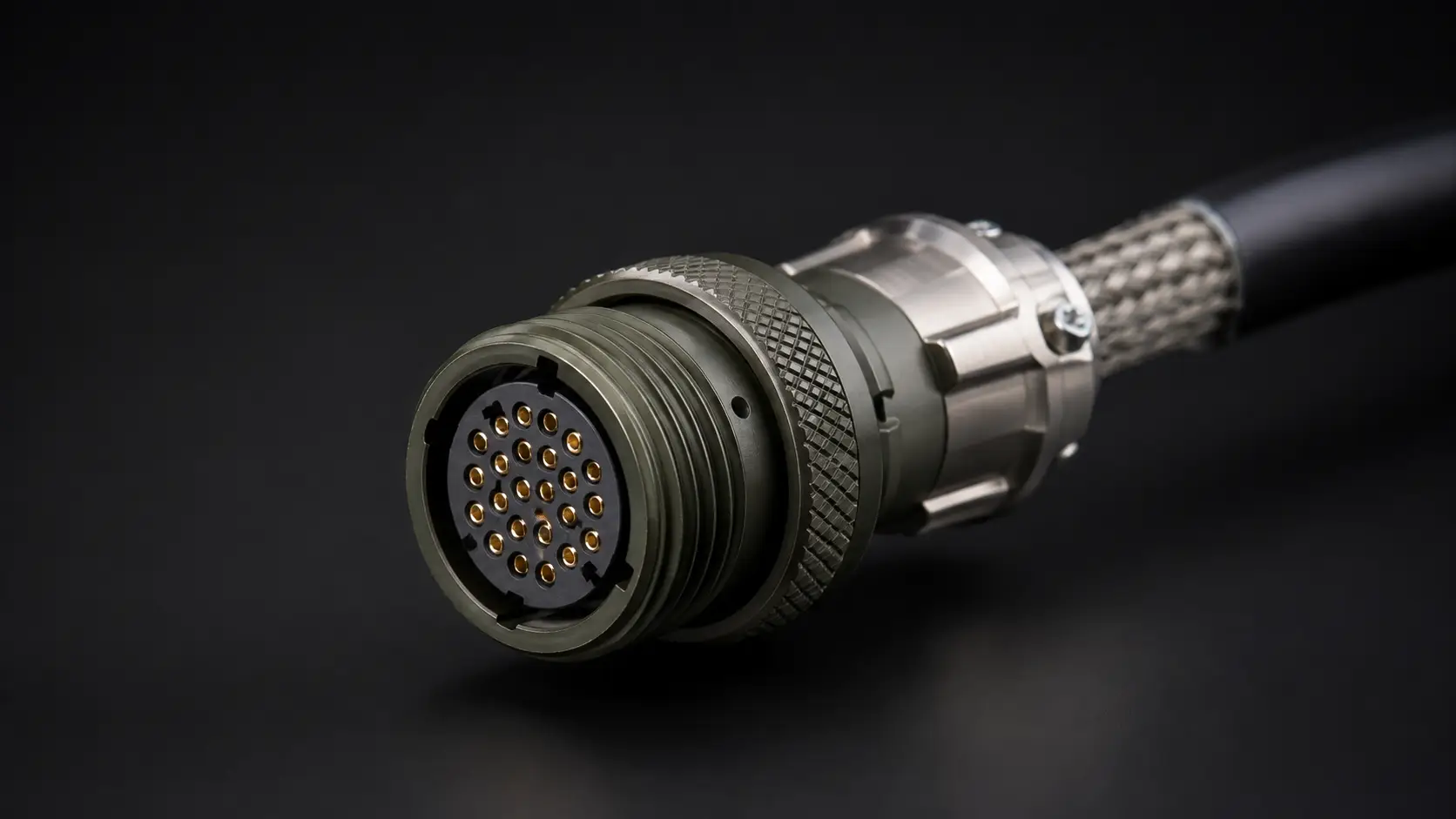
A circular connector is a cylindrical connector in which the contacts are arranged radially inside a round shell, with a keyed insert that only allows the plug and receptacle to mate in one orientation. That shell, usually metal and sometimes composite, is what sets circular connectors apart from rectangular or PCB-mount types: it gives a full 360° of shielding, a much larger sealing and locking interface, and a coupling mechanism that can be torqued, threaded or latched to resist vibration. Rectangular and board-level connectors can pack in more contacts per square centimetre and cost less, but they rarely match a circular connector's resistance to shock, vibration, moisture and repeated mating cycles, which is exactly why circular connectors dominate cockpits, engine bays, radar systems and anything else that has to keep working after being shaken, soaked and temperature-cycled for twenty years.
MIL-DTL-38999 vs. MIL-DTL-5015: why the newer standard took over
Before MIL-DTL-38999 existed, MIL-DTL-5015 was the standard circular connector for military and industrial equipment. It's a solid, simple design dating back to the 1930s and 40s, built around a single-start threaded coupling, but it's large, heavy, and limited to a relatively low contact density (up to around 128 contacts). It's still specified today, mostly for legacy platforms, high-current applications like generators and heavy equipment, and situations where cost matters more than weight.
MIL-DTL-38999 was developed to fix exactly those limitations. It's compact and lightweight for its contact count, supports far higher density (up to around 156 contacts in a comparable shell size), and, unlike MIL-DTL-5015's single coupling option, offers a choice of bayonet, threaded and breech-lock coupling styles across its four series. That flexibility is why it became, and remains, the default standard for new aerospace and defense designs: military aircraft, unmanned systems, and any high-tech platform where every gram and every millimetre counts.
Rule of thumb: if you're maintaining or repairing an existing MIL-DTL-5015 installation, stay with 5015. If you're specifying a connector for a new design, MIL-DTL-38999 is almost always the better starting point.
MIL-DTL-38999 Series I–IV, compared
The four series share a family resemblance (same general shell architecture, same keying logic), but differ enough in coupling and performance that picking the wrong one is a genuinely common mistake.
| Series | Coupling | Typical use | Notable specs |
|---|---|---|---|
| I | Bayonet | Legacy cable-to-panel work; today also marine electronics, communications, medical instrumentation, test equipment | Shell sizes 9–25 |
| II | Bayonet, low-profile shell | Civil and military aerospace where a compact envelope matters | Shell sizes 8–24; strong EMI shielding and resistance to shock, vibration and fluid ingress |
| III | Triple-start threaded | The default for new high-reliability designs: jet engine control systems, ground vehicle navigation electronics, long-service-life radar | Shell sizes 9–25; rated to roughly 200°C and 44g vibration; ~500 mating cycles; available in aluminium, stainless steel, composite, titanium and bronze; meets Boeing BACC63 and Airbus EN3645 |
| IV | Breech (quick-release bayonet) | Field-deployable communications kits, modular drone avionics, quick-test stations, anywhere connectors are mated and unmated often | High vibration resistance and strong EMI shielding, traded for much faster mate/unmate than Series III |
In practice, Series III has become the most widely specified of the four: its threaded coupling gives the best shell-to-shell contact (and therefore the best EMI shielding) and the best resistance to vibration-induced loosening, which is why it's the reference point for both Boeing and Airbus specifications. Series IV exists for the opposite priority: when a connector genuinely needs to come apart and go back together quickly and often, a threaded connector becomes the bottleneck, and the breech-lock coupling of Series IV solves that at a modest cost in ultimate vibration performance. Series I and II are less commonly specified for new designs today but remain important for sustaining legacy platforms and lower-profile aerospace applications.
How to actually choose: a five-point checklist
- What's the vibration and shock profile of the application? Sustained high vibration favours Series III's threaded lock; occasional, lower-intensity vibration leaves more room for Series IV.
- How often will it be mated and unmated? A connector installed once and left for the life of the platform should be threaded (Series III). A connector that a technician will disconnect regularly for maintenance or testing should be quick-release (Series IV).
- How much EMI shielding do you need? Signal-critical or RF-adjacent circuits generally want the superior shell-to-shell contact of a threaded coupling.
- What's your weight and space budget? This is where MIL-DTL-38999 as a family already wins over MIL-DTL-5015, but low-profile applications should look specifically at Series II.
- What happens downstream of the connector itself? The series you choose has to work with your contact material, contact plating, backshell and environmental sealing requirements. It's worth specifying all five together rather than locking in the connector first and working backwards.
Souriau and Glenair: two trusted names, one source
Both of the major connector brands Incotech carries, Souriau and Glenair, manufacture across the MIL-DTL-38999 series range, and because the standard is built around form, fit and function commonality, connectors from either brand are generally designed to interoperate at the mating interface. That said, "generally" isn't "always": backshell threads, keying and finish can vary slightly between manufacturers, so it's worth confirming exact part-to-part compatibility before you mix brands within one assembly. This is precisely the kind of detail Incotech's team checks as a matter of course when specifying parts for a build.
Common mistakes to avoid
- Defaulting to Series III out of habit, even when the application actually needs the fast mate/unmate of Series IV.
- Overlooking keying and orientation early in the design, which turns into a rework problem once the harness is built.
- Locking in the connector before checking backshell and cable compatibility, instead of specifying the full interconnect system together.
- Treating "MIL-spec" as one interchangeable category: a Series I bayonet connector and a Series III threaded connector solve different problems and are not drop-in substitutes for each other.
FAQ
What does MIL-DTL-38999 actually mean? It's the U.S. military detail specification number for a family of miniature, high-density circular electrical connectors, published and maintained under the Defense Logistics Agency's DLA Land and Maritime specifications.
What's the difference between Series I and Series III? Series I uses a bayonet coupling and is largely a legacy design today; Series III uses a triple-start threaded coupling and is the most widely specified series for new high-reliability designs, thanks to its stronger vibration resistance and EMI shielding.
Is MIL-DTL-38999 the same as "D38999"? Yes, "D38999" is simply the common shorthand for MIL-DTL-38999 connectors, used interchangeably across the industry and in most manufacturers' part numbering.
Can I mix a Souriau plug with a Glenair receptacle? Often yes, since both are built to the same mil-spec interface, but always confirm exact compatibility (including backshell threading) before finalising a design. Incotech can check this for you.
Get the right series the first time
Choosing between Series I, II, III and IV isn't something to guess at from a datasheet. It's worth a five-minute conversation before it becomes a five-week rework. Get in touch with Incotech's team to talk through your application, or browse the full range of connectors Incotech stocks for aerospace and defense programmes.