
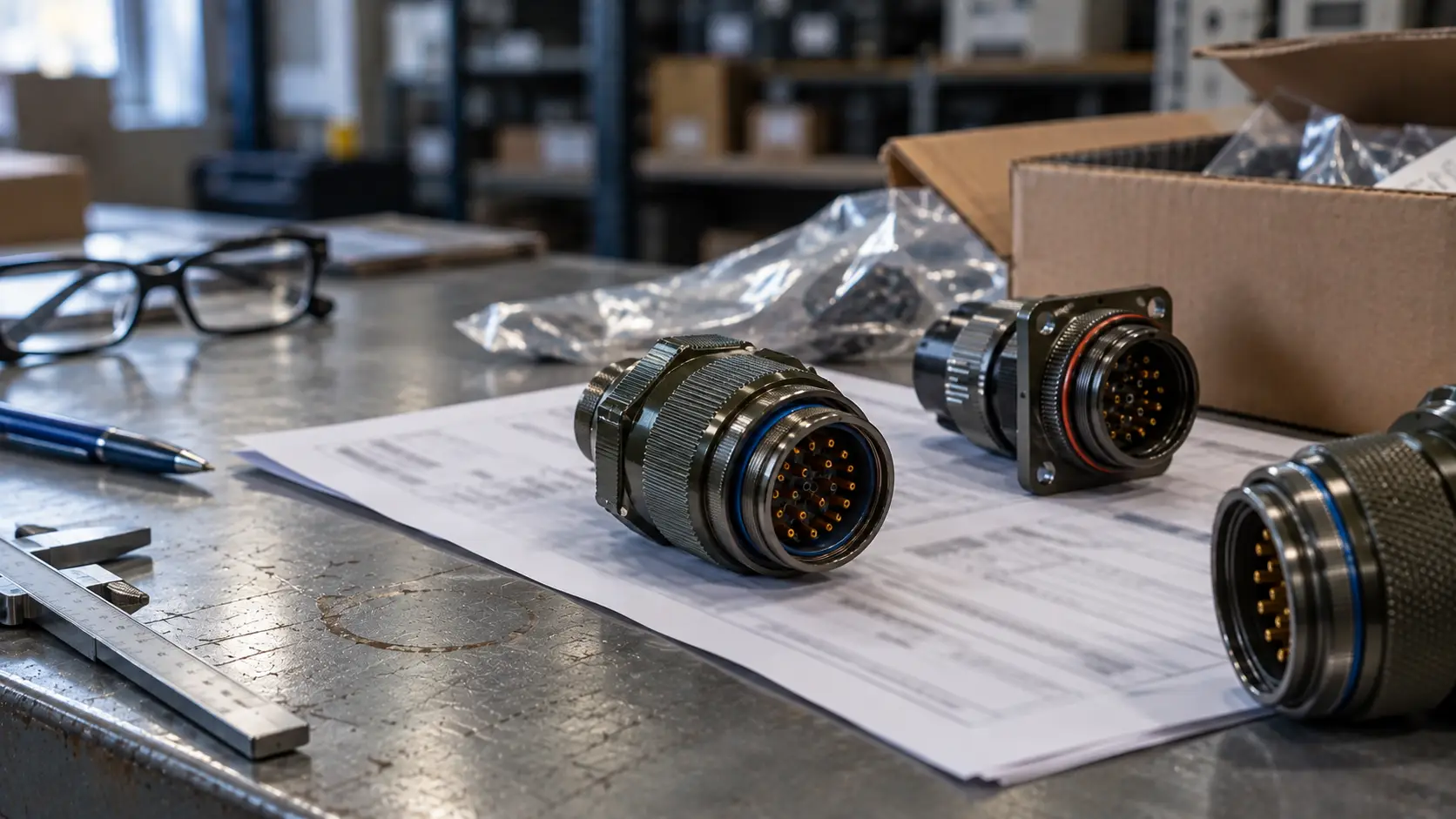
A certificate of conformity arrives with a box of D38999 connectors. It carries the part number, a date, a stamp, a signature, and the words “conforms to specification”. An auditor would accept it. It proves almost nothing about where those connectors came from.
Component traceability is the chain between the original manufacturer and the part in your hand, and the paperwork is only its shadow. Most buyers ask for a certificate. Far fewer ask the question the certificate cannot answer: who had the part between the factory and the invoice, and can anyone demonstrate it.
If you already have the part number and simply want it sourced with the right documents, the fastest route is the quote form with the part number, quantity and the certificates your customer demands, or a call to +31 (0)341 557885.
What Does Component Traceability Actually Mean?
Traceability is the documented ability to track a part from the original manufacturer to the point the customer accepts it. Under DFARS 252.246-7008, dated January 2023, a contractor who is not the original manufacturer or an authorized supplier must hold risk-based processes that enable exactly that tracking, and must keep the documentation available for inspection.
Note what that clause does not say. It does not say “obtain a certificate”. A certificate is an output of traceability where traceability exists, and a piece of letterhead where it does not.
Our article on cable assembly acceptance criteria settled what a finished harness has to meet on the bench, and argued that passing inspection is not the same as being qualified. Provenance is the gap sitting behind both. A harness can be built correctly, inspected properly, and still be assembled from parts nobody can trace.
Three Routes to the Same Part Number
Every part you buy arrives by one of three routes, and the regulation names them. DFARS 252.246-7008 requires contractors to work down this list in order rather than shopping on price.
| Route | What the clause calls it | Evidence you can expect | Who carries the risk |
|---|---|---|---|
| Factory, or a distributor with written authority from it | Original manufacturer or authorized supplier | Unbroken chain to the factory, manufacturer certificates | The manufacturer stands behind the part |
| A supplier you have assessed and approved yourself | Contractor-approved supplier | Whatever your own assessment captured | You do, explicitly |
| Anyone else, including brokers and surplus stock | A source other than the above | Chain of custody usually unknown | You do, and you must notify the contracting officer |
That third row is the one that matters commercially. Buy there and the clause requires you to notify the contracting officer in writing, take responsibility for inspection, testing and authentication, and make that documentation available on request. The cheap part has just acquired a test programme and a disclosure obligation.
The Definition That Leaves Connectors Outside
Here is the part most quality manuals get wrong.
DFARS 252.246-7008 defines an electronic part as an integrated circuit, a discrete electronic component such as a transistor, capacitor, resistor or diode, or a circuit assembly. A bare connector is none of those. Neither is a backshell, a contact or a reel of wire. On a strict reading, the counterfeit-parts regime that engineers quote at each other does not formally reach the interconnect hardware at all.
That is not permission to relax. Two things close the gap. Primes flow the clause down across whole commodity groups without parsing the definition, so your purchase order probably says it applies whatever the regulation says. And the qualification route does the real work: a MIL-DTL-38999 connector is only a 38999 connector because a named manufacturer holds qualification against the specification, whichever series you are specifying. DLA lists Revision N Amendment 2, dated 27 July 2026, as the active general specification, prepared by DLA Weapons Support in Columbus. A shell that matches the drawing but was never qualified against that document is a lookalike, and no certificate changes that.
So the honest position is this. The regulation will not protect you on connectors. Your own specification of provenance has to.
The Rule That Surprises Everyone
Find a suspect part and the instinct is to send it back for credit. You cannot.
DFARS 252.246-7007, also dated January 2023, requires that counterfeit and suspect counterfeit electronic parts are not returned to the seller or otherwise returned to the supply chain until they are determined to be authentic. The same clause requires reporting to the contracting officer and to the Government-Industry Data Exchange Program, and lists screening those reports as one of the twelve things a counterfeit avoidance system has to cover.
Picture a turret harness rebuild on an armoured vehicle programme. Purchasing finds a surplus batch of D38999 shells at a third of list price, with a certificate of conformity in the box, and goods-in accepts them against the part number. Eight months later the customer’s quality team asks for chain of custody on that batch. Nobody can produce it. The shells are already crimped into forty harnesses, so the quarantine reaches the assemblies rather than the parts, and the rebuild runs through a production slot that was booked for something else.
Read the clause as a commercial fact rather than a compliance one. A suspect batch is not a returnable purchase. It is a write-off plus a report carrying your company’s name.
No Amount of Testing Settles It
Suppose you take the risk and send the parts for authentication. There is a standard for that: SAE AS6171, issued 30 October 2016 by the G-19A Test Laboratory Standards Development Committee, with AS6171A following in April 2018. It standardizes inspection and test procedures for suspect counterfeit parts.
Its own scope contains the sentence that should end most of these debates. AS6171 states plainly that no amount of testing can confirm an item as authentic. Testing can find fakes. It cannot manufacture a pedigree that was never recorded.
Which is why this judgement is hard, and why the datasheet will not settle it. You are weighing a known price against an unknown provenance, under schedule pressure, on a part that is often no longer available through the first route at all. If you are at that point, send us the part number, the quantity and the programme it is going into, and say which certificates your customer insists on. You will get back availability, lead time, and a straight answer on exactly which documents can travel with the parts and which cannot. Where the answer is that we cannot supply it with the pedigree you need, you will get that too.
What AS9120 and AS6081 Actually Certify
Distributor certifications get quoted as though they were all the same claim. They are two different claims.
SAE AS9120B, revised 1 November 2016 by the G-14 Americas Aerospace Quality Standards Committee, is a quality management system standard for aviation, space and defence distributors. Built on ISO 9001, it adds industry requirements for the people who stock and resell rather than manufacture, and governs how a distributor runs: records, traceability processes, control of nonconforming product.
SAE AS6081A, revised 21 April 2023 by the G-19 Counterfeit Electronic Parts Committee, is narrower and more specific. It covers independent distribution, and it standardizes practices for identifying reliable sources, assessing and mitigating the risk of passing on suspect counterfeit parts, and reporting incidents.
The distinction is practical. AS9120 says the house is in order. Hold AS6081 as well and the house has a counterfeit-avoidance process for stock bought outside the authorized chain. A distributor working entirely within the authorized chain has less need of the second. Ask which applies and to which part of their stock, rather than collecting logos.
How Long the Paperwork Has to Survive
Retention is where traceability quietly fails years later, because the regulation asks for far less than a programme actually needs.
FAR 4.703 requires contractors to make records available for three years after final payment, or the specific periods in FAR 4.705, whichever expires first. Within that, FAR 4.705-1 sets four years for most financial and cost accounting records and two years for labour cost distribution. Those are accounting horizons.
Now set them against an airframe or a naval platform that stays in service for thirty or forty years. A connector fitted in year two may be investigated in year twenty-five, long after the three-year clock expired and the distributor’s own filing policy ran out. Incotech archives certification documents for a minimum of thirty years and holds AS 9120 with ISO 9001, which is the kind of horizon the hardware actually lives on. Worth asking any supplier what their number is, because the regulation will not set it for them.
What Makes an Enquiry Answerable
Three details decide how fast a request can be priced. The manufacturer part number and the quantity per line, or the bill of materials as a file rather than retyped. A target delivery date, because lead times on mil-spec connectors vary widely by series and shell plating, and flagging a long-lead item before you commit to a build schedule is worth more than flagging it after. And the application, because knowing whether an assembly is bound for aerospace, defence, offshore or industrial automation lets a sales engineer check the part is right for the environment rather than just available.
Send those three and you get a real answer first time. A part number on its own gets a question back.
You do not need a part number to start. A drawing, a photograph of an existing connector, or a competitor’s part number is usually enough to work backwards from, and our design support engineers can review a requirement before anything is ordered. Describing the application and the connection you are trying to make is a legitimate opening, not an admission of ignorance.
Five Questions Before the PO
Print this, or paste it into the enquiry. It separates a supplier who can evidence provenance from one who can only produce a certificate.
- Which route did this stock arrive by: factory, authorized distribution, or independent purchase?
- Can you demonstrate the chain of custody from the original manufacturer, and will that documentation travel with the parts?
- Is the manufacturer qualified against the governing specification for this part number, and which revision?
- How long do you retain certification records, in years?
- If the parts are later judged suspect, what is your process, and who reports to GIDEP?
A supplier who answers all five in writing is worth paying more. One who answers the first three with “we have a certificate of conformity” has told you which route the stock came by.
When Buying From a Certified Distributor Is Still the Wrong Call
Honest bad news, because this article would be an advertisement without it.
A certified distributor costs more than a broker. Sometimes considerably more, and for a non-critical industrial build with a short service life and an accessible connector, that premium buys you very little. If the assembly is a test rig that lives in a dry workshop for two years, the pedigree argument is weak and you should say so to whoever is insisting on it.
There is also the case where nobody can help. If a part is genuinely out of production with no authorized stock anywhere, a certified distributor cannot conjure provenance either. What it can do is tell you that honestly and early, rather than selling you surplus with a certificate attached. The useful question then becomes whether a qualified alternative exists, which is a design conversation and not a purchasing one.
And where the honest answer is that it depends, it depends on four things: the consequence of a failure in service, how long the platform stays in service, whether your customer’s purchase order flows down counterfeit clauses, and whether you have the test budget to authenticate parts you cannot trace.
Frequently Asked Questions
What is a certificate of conformity?
A supplier’s written statement that the goods supplied meet a stated specification. It is a claim rather than evidence of origin. Under DFARS 252.246-7008, what the regulation requires is a documented process that tracks a part from the original manufacturer to acceptance, which is a different and much harder thing to produce.
Does the DFARS counterfeit clause apply to connectors?
Not on a strict reading. DFARS 252.246-7008 defines an electronic part as an integrated circuit, a discrete component such as a transistor or resistor, or a circuit assembly. A connector is none of those. Primes commonly flow the clause down across all commodities anyway, so check your purchase order rather than the definition.
Can testing prove a part is genuine?
No. SAE AS6171 states in its own scope that no amount of testing can confirm an item as authentic. Inspection and test can detect many counterfeits, which is useful, but they cannot reconstruct a chain of custody that was never documented. Provenance has to be established before purchase, not after.
What is the difference between AS9120 and AS6081?
AS9120B is a quality management system standard for aviation, space and defence distributors, building on ISO 9001. AS6081A is narrower: it covers independent distribution and standardizes counterfeit avoidance, risk mitigation and incident reporting. A distributor may hold one, both, or neither, and each covers a different question.
How long should certification records be kept?
FAR 4.703 requires records to be available three years after final payment, with FAR 4.705-1 setting four years for most financial records. Those periods are far shorter than the service life of an airframe or naval platform, so ask suppliers for their own retention period in years rather than assuming the regulation covers it.
Can I return a suspect counterfeit part for credit?
No. DFARS 252.246-7007 requires that counterfeit and suspect counterfeit parts are not returned to the seller or to the supply chain until determined authentic. The clause also requires reporting to the contracting officer and to GIDEP. A suspect batch is a quarantined loss rather than a returnable purchase.
Price Is Negotiable, Pedigree Is Not
The purchasing conversation usually runs on unit price, lead time and payment terms, all of which are negotiable. Provenance is not. Either someone recorded who held the part between the factory and your goods-in, or nobody did, and no amount of commercial pressure creates that record afterwards.
Which makes the certificate of conformity a strange document to build a supply chain on. It is the one piece of paper that looks like proof and functions as a promise. Ask the five questions instead. A supplier who can answer them has traceability; a supplier who cannot has stock.
Sources
The technical figures in this article come from the following documents.
- United States Government. Sources of Electronic Parts, DFARS 252.246-7008 (January 2023). Accessed 12 October 2026.
- United States Government. Contractor Counterfeit Electronic Part Detection and Avoidance System, DFARS 252.246-7007 (January 2023). Accessed 12 October 2026.
- United States Government. Policy, FAR 4.703. Accessed 12 October 2026.
- United States Government. Financial and cost accounting records, FAR 4.705-1. Accessed 12 October 2026.
- SAE International. Counterfeit Electrical, Electronic, and Electromechanical (EEE) Parts: Avoidance, Detection, Mitigation, and Disposition - Independent Distribution, AS6081A (2023). Paid standard, available from SAE International. Accessed 12 October 2026.
- SAE International. Quality Management Systems: Requirements for Aviation, Space, and Defense Distributors, AS9120B (2016). Paid standard, available from SAE International. Accessed 12 October 2026.
- SAE International. Test Methods Standard; General Requirements, Suspect/Counterfeit, Electrical, Electronic, and Electromechanical Parts, AS6171 (2016). Paid standard, available from SAE International. Accessed 12 October 2026.
- Defense Logistics Agency. MIL-DTL-38999 Revision N Amendment 2, Connectors, Electrical, Circular, Miniature, High Density, Quick Disconnect, Environment Resistant (2026). Accessed 12 October 2026.
Incotech supplies connectors, backshells, wire and cable, and builds custom cable assemblies for aerospace, defence, offshore and industrial programmes, with certification documents archived for a minimum of thirty years. If you are chasing provenance on a part number your customer has queried, or deciding whether a surplus offer is worth the test programme attached to it, our engineers will work through it with you.