
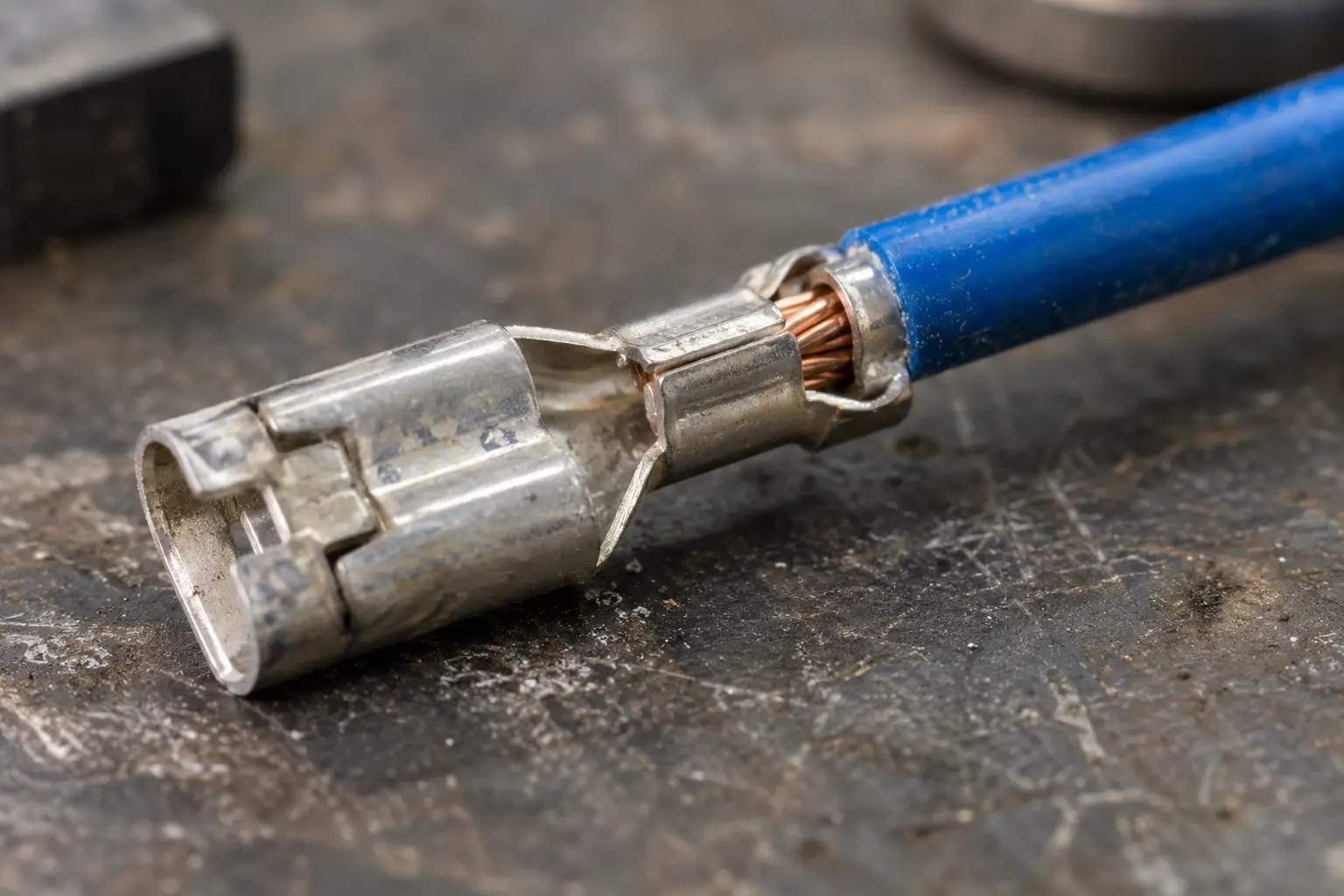
A batch of 240 harnesses clears a customer's incoming inspection without a single reject. The next batch, built on the same bench by the same two operators against the same drawing, comes back with nineteen. Nothing on the shop floor changed. What changed was the document number printed on the purchase order, and neither side had opened it.
Cable assembly acceptance criteria are the clauses that decide whether a finished harness ships or gets rebuilt at somebody's cost. They live in documents purchasing rarely sees and that assembly shops often own exactly one copy of. Three of them cover most high-reliability work in Europe. They disagree with each other on points that matter, and two of the three cost nothing to download.
What Do Cable Assembly Acceptance Criteria Actually Cover?
Acceptance criteria define the measurable limits a finished cable assembly must meet: crimp tensile strength, insulation clearance at the barrel mouth, permitted strand damage, shield termination and marking, plus the inspection method used to judge each one. They also govern the process behind the build, including tool verification frequency, in-process sample testing and how long an operator's certification stays valid.
That second half is what surprises people. You can build a technically sound harness and still fail an audit because the crimp tool went unverified for eighteen months, or because the operator who built it was certified in 2022 and never requalified.
Three Documents, Three Different Worlds
Most European harness work is judged against one of three documents, and which one applies to you is decided by your customer's contract rather than by your own quality manual.
IPC released Revision E of IPC/WHMA-A-620, Requirements and Acceptance for Cable and Wire Harness Assemblies, on 22 December 2022, adopting a new chaptering system, aligning its soldering requirements with IPC J-STD-001 and revising the Circular Mil Area specification. That document is the commercial and industrial default, and the only one of the three you cannot read without paying: the ANSI webstore lists the PDF at $351.
The other two are free. NASA-STD-8739.4A with Change 4 covers crimping, interconnecting cables, harnesses and wiring, and has been mandatory for NASA critical work since its approval on 13 April 2022. ECSS-Q-ST-70-26C Rev.1, published by the ESA Requirements and Standards Division at ESTEC in Noordwijk, covers crimping of high-reliability electrical connections for spacecraft.
If you build for aerospace, defence or space programmes and have never opened either of the free ones, that is the cheapest afternoon of technical reading available to you.
Where the Crimp Tooling Article Stopped
Our guide to MIL-spec crimp tools, positioners and selector settings closed with four instructions: put the tool, positioner and selector setting on the assembly drawing, specify the gage interval, name the pull-test standard, and name the sample size. Sensible advice. It did not say where those numbers come from.
They come from these three documents, and the values are not interchangeable. Pick the wrong parent standard and you will specify a gage interval that your customer's auditor rejects, or a pull force that a perfectly good crimp fails.
The Pull Test Is Not One Test
NASA-STD-8739.4A publishes a fixed table of minimum tensile values by wire gauge: 22 N (5 lb) for 28 AWG, 57 N (13 lb) for 22 AWG, and 459 N (103 lb) for 12 AWG. The same standard fixes the tensile head travel speed at 25.4 ± 6.3 mm (1.0 ± 0.25 in) per minute, and blocks production until three consecutive samples pass with zero failures.
ECSS-Q-ST-70-26C Rev.1 does it differently. Rather than a table, it sets the acceptance value at 75 % of the intrinsic strength of the wire being crimped. That puts the burden on knowing what the conductor actually is, down to the slash sheet.
That difference is not cosmetic, and the ESA approach is the better engineering. A fixed table is calibrated to the weakest wire you are likely to see at that gauge. Put a high-strength alloy conductor from your wire and cable range in the same barrel and a mediocre crimp will still clear 57 N while giving up far more than 25 % of what the wire could carry. The fixed table passes it. A percentage rule catches it.
Most specifications copy the table anyway, because a table is easier to write into a work instruction. A reason, not a justification.
Tool Control Is Contractual, Not Advisory
Tool verification is where audits are actually lost. ECSS-Q-ST-70-26C Rev.1 requires four samples to be tested after every 250 crimping operations, and a full set of validation activities every 12 months or every 1500 crimps, whichever comes first. Operator certification under that standard stays valid for two years.
NASA-STD-8739.4A comes at the same problem from the hardware side. It requires each crimp tool to have four or more indenter blades, preferably double-indenter, and requires every adjustable crimp tool to be set, sealed or locked and verified before use.
Read those two requirements together and a common shop-floor habit falls apart: the adjustable frame that lives in a drawer, gets borrowed for a different contact size, and goes back without being reset. Sealed means sealed.
A-620E, NASA and ECSS Side by Side
| Requirement | IPC/WHMA-A-620E | NASA-STD-8739.4A w/Ch.4 | ECSS-Q-ST-70-26C Rev.1 |
|---|---|---|---|
| Cost to obtain | $351 (ANSI webstore) | Free download | Free download |
| Crimp tensile acceptance | Paid standard, not quoted | Fixed table by gauge (57 N at 22 AWG) | 75 % of intrinsic wire strength |
| In-process sampling | Paid standard, not quoted | Zero failures out of three before production proceeds | Four samples every 250 crimps |
| Tool validation interval | Paid standard, not quoted | Verified before use; set, sealed or locked | Every 12 months or 1500 crimps |
| Operator certification | Paid standard, not quoted | Per NASA-STD-8739.6, Chapter 5 | Valid two years |
| Wires per crimp barrel | Paid standard, not quoted | Stranded wire only, no solid wire | Maximum of two |
| Workspace conditions | Paid standard, not quoted | Not specified numerically | 1080 lux min, 22 ± 3 °C, 55 ± 10 % RH |
That second column is the point. A shop asked to certify to A-620E cannot benchmark its own practice against the alternatives without spending $351 first.
The Two Clauses That Cause Most Rework
Insulation clearance is the first. NASA-STD-8739.4A sets a minimum of 0.25 mm (0.01 in) between the insulation and the crimp barrel, and a maximum of 0.75 mm (0.03 in) for conductors 20 AWG and smaller. ECSS-Q-ST-70-26C Rev.1 allows 0.3 mm to 1.0 mm for 28 to 16 AWG, and 0.3 mm to 2 mm above 16 AWG.
Almost everyone polices the minimum. Insulation caught in the barrel is visible, embarrassing and easy to reject, so inspectors look for it. The maximum gets waved through, and the maximum is the one with teeth. Every millimetre of bare conductor beyond the barrel is unsupported strand. Under vibration it flexes at a fixed point, work-hardens, and fractures just outside the barrel mouth where no pull test and no visual inspection will ever find it.
Strand damage is the second. NASA-STD-8739.4A permits nicked shield strands up to 10 % of the total strand count, and requires visual inspection aided by magnification between 4X and 10X. A 10 % allowance sounds generous until you watch a mechanical stripper chew a 26 AWG shield.
A Slew-Ring Harness That Passed Every Inspection
Picture the control harness running through the slew ring of a pedestal crane on an offshore platform. It rotates, it never stops rotating, and it is wet and salty for its entire service life. The crimps on that harness are inspected, pull tested and signed off. Three years in, two circuits go intermittent in cold weather and come back when the sun hits the housing.
Nobody finds the fault for weeks, because the crimp is perfect. Strip one back and the break is 1.5 mm beyond the barrel, in bare copper, with the insulation sitting a comfortable distance away exactly as the technician was taught to leave it. The stripping length was set once, on a Monday, by someone who knew about the minimum gap and had never been told there was a maximum.
That failure is invisible to every acceptance test in all three standards, because acceptance testing happens before the vibration does. It is prevented at the stripping station, not at the inspection bench. Our article on the most common causes of connector failure treats poor crimp quality as one cause among ten. This is the version of it that passes inspection.
One practical answer is to take the operator's judgement out of the strip. A thermal stripper removes insulation with heat instead of blades, which eliminates nicked strands and makes the strip length repeatable across a shift.
Workmanship Is Not Qualification
Here is the limitation nobody selling cable assemblies likes to state plainly: meeting every acceptance criterion in any of these three documents tells you the harness was built correctly. It does not tell you the harness will survive its environment.
Those are different tests, run against different documents. RTCA lists DO-160G, Environmental Conditions and Test Procedures for Airborne Equipment, published in 2010, as the current revision for airborne equipment, with DO-160H announced for 2026. The FAA's AC 21-16G, issued 22 June 2011, accepts DO-160 versions D through G for environmental qualification and identifies Section 8 of that document as vibration. Installation is a third document again: SAE AS50881, Wiring, Aerospace Vehicle, revised in January 2023, covers selection through installation of aerospace vehicle wiring.
A harness can be A-620 compliant, correctly installed per AS50881, and still fail DO-160 Section 8 because the strain relief was wrong. Which is a backshell decision, not a workmanship one. Anyone ordering built cable assemblies should ask which of the three regimes the supplier certifies to, and ask separately what environmental qualification the design has behind it.
The Strictest Standard Is Not Automatically the Right One
There is a reflex in high-reliability purchasing that says specify the hardest standard available and you cannot be criticized. It is expensive and it is often wrong.
Apply ECSS-Q-ST-70-26C Rev.1 to a harness for an agricultural vehicle and you have committed to 1080 lux of controlled lighting, a workspace held at 22 ± 3 °C and 55 ± 10 % relative humidity, four destructive samples every 250 crimps, and two-yearly recertification of every operator. For a spacecraft harness that cannot be repaired after launch, all of that is proportionate. On a seed drill you have roughly doubled assembly cost to guard against a failure whose consequence is a service call.
So which standard applies to you? It depends, and it depends on four specific things: what your customer's contract flows down, whether the assembly is repairable in service, what one intermittent circuit actually costs, and whether you will ever have to prove conformity to an auditor who has read the document. Answer those four and the choice is usually obvious. Skip them and you will default to the most expensive option on the table.
What Belongs on the Drawing
The parent standard and its revision, by full number. Contact part number with its matching tool, positioner and selector setting. Strip length with a tolerance, and both the minimum and maximum insulation clearance. Pull-test value with the clause it comes from, the sample size, and the head travel speed. Tool verification interval, stated in months and in crimps. The inspection magnification range.
Nine items. A drawing that carries all nine cannot be argued about at incoming inspection, which is the entire point.
Revisions move faster than drawings do, so the first item needs a date check rather than a copy and paste. MIL-DTL-38999 reached Revision N Amendment 2 on 27 July 2026 at DLA Weapons Support in Columbus, which is worth knowing if your Series III callout was written against an older revision and has been reissued unchanged ever since.
Frequently Asked Questions
Which cable assembly standard should I specify?
Whichever one your customer's contract flows down. Where no standard is specified, IPC/WHMA-A-620E is the commercial default for industrial and most aerospace subcontract work. For space hardware, ECSS-Q-ST-70-26C Rev.1 applies in Europe and NASA-STD-8739.4A in the United States. Specifying two standards at once creates conflicts you will have to resolve later.
Is IPC/WHMA-A-620 free to download?
No. IPC/WHMA-A-620E is a paid standard, listed on the ANSI webstore at $351 for the PDF. The two space-sector equivalents are free: NASA-STD-8739.4A is published at standards.nasa.gov and ECSS-Q-ST-70-26C Rev.1 at ecss.nl. Reading the free ones first is a reasonable way to understand the subject before buying.
How often must crimp tools be verified?
It depends on the governing standard. ECSS-Q-ST-70-26C Rev.1 requires validation every 12 months or every 1500 crimps, whichever comes first, plus four test samples after every 250 crimping operations. NASA-STD-8739.4A requires verification before use and that adjustable tools be set, sealed or locked rather than left adjustable on the bench.
What pull force should a finished crimp withstand?
Minimum values by gauge in NASA-STD-8739.4A include 57 N (13 lb) at 22 AWG and 459 N (103 lb) at 12 AWG. ECSS-Q-ST-70-26C Rev.1 takes a different route, requiring 75 % of the intrinsic strength of the wire being crimped. Our crimp tooling article covers test method and sample size in more detail.
Can insulation clearance be too large?
Yes, and this is the clause most often missed. NASA-STD-8739.4A caps clearance at 0.75 mm (0.03 in) for conductors 20 AWG and smaller. Excess bare conductor beyond the barrel is unsupported under vibration, work-hardens at a fixed flex point, and fractures outside the barrel where inspection cannot see it.
Does passing acceptance inspection mean the harness is qualified?
No. Acceptance criteria confirm the assembly was built correctly. Environmental survival is proven separately, for airborne equipment against RTCA DO-160, whose Section 8 covers vibration according to FAA AC 21-16G. Installation practice is a third document again, SAE AS50881 for aerospace vehicle wiring.
Buying the Standard Costs Less Than Rebuilding the Harness
The economics here are not subtle. One rejected batch of fifty harnesses costs more in rework labour, freight and schedule than every document named above combined, including the paid one. Yet the usual pattern is a purchase order that names a standard nobody in the building has read, and a drawing that leaves the strip length to whoever is on shift.
Two habits fix most of it. Read the free standards even if you are contractually bound to the paid one, because they explain the physics the acceptance limits are protecting against. Then put the numbers on the drawing instead of in a training memory.
Specifications do not fail at incoming inspection. Assumptions do.
Sources
The technical figures in this article come from the following documents.
- NASA. Workmanship Standard for Crimping, Interconnecting Cables, Harnesses, and Wiring, NASA-STD-8739.4A with Change 4 (2022). Accessed 17 September 2026.
- ESA Requirements and Standards Division. Space product assurance: Crimping of high-reliability electrical connections, ECSS-Q-ST-70-26C Rev.1, Corrigendum 1 (2017). Accessed 17 September 2026.
- IPC. IPC Releases IPC/WHMA-A-620E, Requirements and Acceptance for Cable and Wire Harness Assemblies (2022). Accessed 17 September 2026.
- IPC and WHMA. Requirements and Acceptance for Cable and Wire Harness Assemblies, IPC/WHMA-A-620E (2022). Paid standard, available from IPC or the ANSI webstore. Accessed 17 September 2026.
- Defense Logistics Agency. MIL-DTL-38999 Revision N Amendment 2, Connectors, Electrical, Circular, Miniature, High Density, Quick Disconnect, Environment Resistant (2026). Accessed 17 September 2026.
- RTCA. DO-160G, Environmental Conditions and Test Procedures for Airborne Equipment (2010). Accessed 17 September 2026.
- Federal Aviation Administration. AC 21-16G, RTCA Document DO-160 versions D, E, F, and G
 (2011). Accessed 17 September 2026.
- SAE International. AS50881, Wiring, Aerospace Vehicle, revised January 2023. Paid standard, available from SAE International. Accessed 17 September 2026.
Incotech supplies connectors, backshells, wire and cable, and builds custom cable assemblies for aerospace, defence, offshore and industrial programmes. If you are writing acceptance criteria into a drawing and want a second opinion on the tooling, strip lengths or test values before it goes out, our engineering support team will go through it with you.