
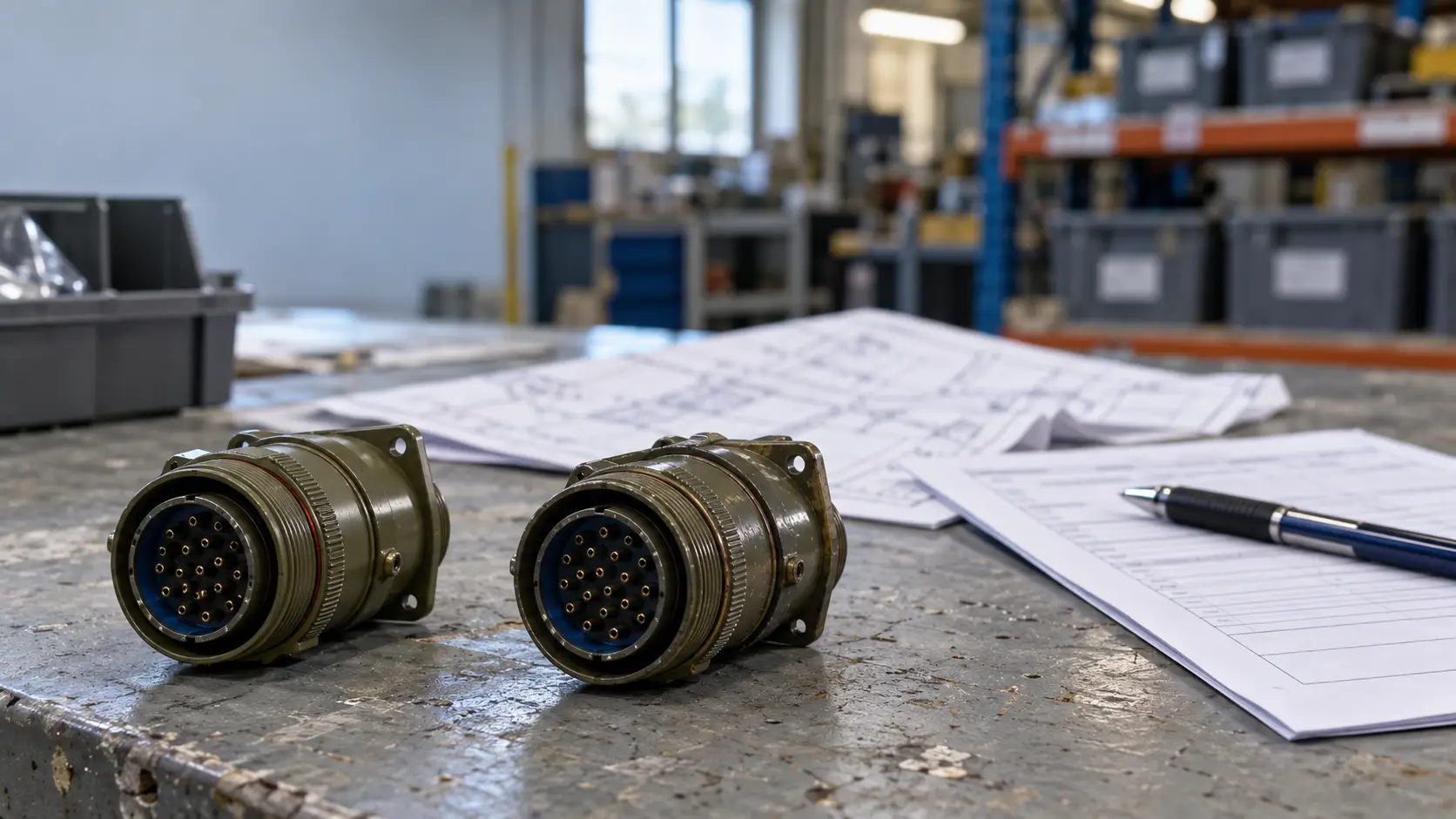
Somebody in the review says the alternate is form, fit and function identical, and the room moves on. That sentence has no standing. It is not a test anyone is obliged to accept, it does not appear in the specification the original connector was bought against, and the defence standard that defined the related terms was cancelled twenty-eight years ago.
Connector substitution fails far more often on authority than on engineering. The alternate usually works. What stalls the build is that nobody can say who is entitled to approve it, and the answer depends on which sector the hardware is going into rather than on how closely the parts match.
If the part you cannot get is already identified and you simply want it sourced, the fastest route is the quote form with the part number, quantity and your target date, or a call to +31 (0)341 557885.
What Does "Form, Fit and Function" Actually Mean?
Form, fit and function describes an item that can replace another without altering installation, interface or performance. It is a useful shorthand and it is not an approval. No specification obliges a customer to accept a part on that basis, and the military standard that defined the surrounding vocabulary was cancelled in 1998.
The phrase survives the document that defined it. Worth knowing before you put it in an email.
The Standard Everyone Cites Was Cancelled in 1998
MIL-STD-280, Definitions of Item Levels, Item Exchangeability, Models, and Related Terms, was cancelled on 12 February 1998 according to its DLA ASSIST record, which dates Revision A to July 1969. The definitions did not disappear. They moved into MIL-HDBK-505, which carries the same title, remains active, and was last revalidated on 5 September 2024.
Read the category field, though. MIL-HDBK-505 is a Defense Handbook, and handbooks are reference material rather than requirements. The vocabulary engineers reach for when arguing two parts are equivalent now lives in a document that cannot settle the argument.
These conversations go in circles because both sides are citing guidance and expecting it to work as a rule.
Qualification Is Not a Property of the Part
The second confusion matters more than the first.
A MIL-spec connector is not qualified because of its part number. It is qualified because a named manufacturer has been through a qualification process against a specific specification, and remains listed. SD-6, Provisions Governing Qualification, dated 1 February 2026, states that a product may be qualified only when a governing federal or defence specification or non-government standard contains a requirement for qualification, and that lists are not otherwise established. Its scope addresses manufacturers and their authorized distributors.
MIL-DTL-38999 is one of those qualification-bearing specifications. Its ASSIST record carries a qualification flag alongside Revision N Amendment 2, dated 27 July 2026, and the specification covers four series of circular connectors operating from -65 °C to +200 °C maximum, or as otherwise specified. A shell built to those dimensions by a manufacturer who was never qualified against that document is a connector that fits. It is not a MIL-DTL-38999 connector in the sense your customer's drawing means.
That is why "it is a 38999" tells you nothing about qualification. The sentence describes a shape.
Who Can Approve an Alternate, and What They Need
Print this one. It moves the question from whether the parts match to who signs, which is what resolves these disputes.
| Where the hardware is going | Who can approve the alternate | Evidence they will expect | Realistic timescale |
|---|---|---|---|
| Defence contract with a qualification callout | The customer's design authority, through the contract's change process | Qualification status of the proposed manufacturer against the same specification sheet | Weeks, and it may be refused outright |
| Type-certificated civil aircraft | The FAA or the type certificate holder, under 14 CFR part 21 | A production approval, standard-part status, or an approved design change | Months, if the route exists at all |
| Military platform using surplus stock | The programme, subject to the origin rules in 14 CFR 21.9 where civil certification also applies | Proof the stock was declared surplus and was intended for that model | Varies, often blocked on provenance |
| Industrial or agricultural equipment, no certification basis | Your own engineering, against your own requirements | Whatever your internal change process demands | Days |
The bottom row is why connector substitution feels easy to people whose experience is industrial and impossible to people whose experience is airborne. Both are describing the system they work in accurately.
A Type-Certificated Aircraft Is a Different Question Entirely
Civil aviation does not treat this as a purchasing decision at all. Under 14 CFR 21.9, a person who knows a replacement or modification article is reasonably likely to be installed on a type-certificated product may not produce it unless it falls into one of a short list of routes. Three matter here: produced under a type certificate, produced under an FAA production approval, or a standard part made in compliance with a government or established industry specification. The regulation also allows a commercial part as it defines one, owner-production, fabrication consumed in a repair by a rated certificate holder, and anything else the FAA approves.
Most of this hardware travels by the third route. A connector built in compliance with a government specification can qualify as a standard part. That is the mechanism by which MIL-spec connectors are installed on civil aircraft at all, and it is also the mechanism that collapses the moment the manufacturer is not actually building to the specification.
Paragraph (b) has a sharper edge. Outside the type certificate and production approval routes, a person producing a replacement article for sale may not represent it as suitable for installation on a type-certificated product. A supplier telling you a part is a drop-in replacement for a certificated aircraft is making a claim the regulation does not permit them to make.
The alternative is a Parts Manufacturer Approval, and 14 CFR 21.303 shows the scale: an applicant must supply the product the article goes on, the manufacturing facility addresses, drawings and specifications showing configuration, dimensions, materials and processes defining structural strength, and test reports showing the design meets the airworthiness requirements. A design-approval programme, not a substitution.
The Surplus Clause People Miss
Surplus military stock looks like the obvious answer when a part is unobtainable. For certificated aircraft it carries a condition most buyers have never read.
Paragraph (c) of 14 CFR 21.9 states that, outside the type certificate and production approval routes, a person may not sell or represent an article as suitable for installation on an aircraft type-certificated under the sections it names unless it was declared surplus by the U.S. Armed Forces and was intended for use on that aircraft model by the U.S. Armed Forces. Two conditions, both about origin, neither about condition or specification.
Picture a depot-level refit on a maritime patrol aircraft. A wing-station harness needs eight Series III plugs and the original part is twenty weeks out. Surplus stock appears at a quarter of the price, physically correct, correctly marked. The harnesses get built. Then the airworthiness paperwork has to say which route under 21.9 the parts arrived by, and the answer is none of them, because nobody can show the stock was declared surplus and intended for that model. The connectors are fine. Signing the aircraft off is the problem.
What Changes When the Part Is Obsolete Rather Than Late
A long lead time and an obsolescence are different problems that produce the same phone call, and the second one closes a door the first leaves open. The cost of an obsolescence lands in engineering hours and requalification evidence, not only in the price of whatever stock is still out there.
DFARS 252.246-7007, dated January 2023, defines an obsolete electronic part as one no longer available from the original manufacturer or an authorized aftermarket manufacturer. The same clause lists control of obsolete parts as one of the twelve areas a counterfeit avoidance system must address, with the stated aim of maximizing the availability and use of authentic, originally designed and qualified parts across the product's life cycle.
That phrasing is doing real work. The preference is not for a clever equivalent but for the original, qualified item, for as long as the programme can get it. Our article on component traceability covered the provenance you need on parts you do buy; the decision here sits one step earlier, on whether to buy a different part at all. Stock agreements and last-time-buy quantities answer the date without touching the specification, often the cheaper route once requalification is priced in.
The Temperature Range Is the Easy Part
Comparing two datasheets is the half of this job that feels productive and the half that misleads.
Shell material, plating, contact arrangement, insert material, sealing, coupling type and operating range are all published and all comparable. None is sufficient, because what differs between two physically identical connectors is usually what nobody prints: the insert moulding process, the plating chemistry, the contact retention design, whether the manufacturer holds qualification against the same specification sheet or a similar one. Those decide whether the part behaves the same in year eight.
The honest answer on whether a given alternate is acceptable is that it depends, and it depends on four things you can establish in a morning: whether the governing specification carries a qualification requirement, whether the proposed manufacturer is qualified against that same specification sheet, what your customer's contract says about changes, and whether any certification basis applies to the end product. Answer those four and the engineering comparison becomes straightforward. Skip them and the engineering comparison is theatre.
If you are weighing a specific alternate, send us the original part number, the proposed alternate, and one line on the programme it is going into. You will get back what we can establish about qualification status for both, what the lead time looks like on the original, and where we think the approval route sits. Where the substitution is not ours to approve, you will get that plainly.
What a Substitution Request Should Contain
Three details decide whether anyone can answer you quickly. The original manufacturer part number, and the quantity per line, or the bill of materials as a file rather than retyped. Your target delivery date, because lead times on mil-spec connectors vary widely by series and shell plating, and a date lets long-lead items be flagged before you commit to a build schedule rather than after. And the application, because that is what lets anyone judge whether the part suits the environment rather than merely being available.
You do not need a part number to open the conversation. A drawing, a photograph of the connector already fitted, or a competitor's part number is usually enough to work backwards from, and design support can review a requirement before anything is ordered. Describing the environment and the connection you are trying to make is a legitimate starting point.
When Substitution Is the Wrong Move
Honest bad news, and it cuts against the sale.
If the end product has a certification basis, substitution is usually the expensive option dressed as the cheap one. The part costs less and the approval costs more, and the approval lands on your engineering department rather than on your purchasing budget, which is why it rarely appears in the comparison. Twenty weeks of lead time on the original is frequently cheaper than four months of design-change work, and more predictable.
We cannot approve a substitution for you. Nobody outside your customer's design authority can, and a distributor who tells you otherwise is describing a commercial preference as a technical finding. What a sourcing network can do is find the original where you were told none exists, which happens more often than the obsolescence notices suggest, and give you the qualification picture on an alternate so the people who do decide have something to work from.
Frequently Asked Questions
Is a form, fit and function equivalent automatically acceptable?
No. It describes physical and functional interchangeability, not approval. MIL-STD-280, which defined the related exchangeability terms, was cancelled in February 1998 and its definitions moved to MIL-HDBK-505, a Defense Handbook giving guidance rather than requirements. Acceptance rests with the design authority, or with the regulation for certificated aircraft.
Does a MIL-DTL-38999 part number mean the connector is qualified?
No. Qualification attaches to a manufacturer assessed against a specification, not to a part number. SD-6 states that a product may be qualified only where the governing specification contains a qualification requirement. MIL-DTL-38999 carries one, so a dimensionally correct shell from an unqualified source is not a qualified connector.
Can I fit a surplus military connector to a civil aircraft?
Only under conditions. 14 CFR 21.9 requires, for the aircraft categories it names, that the article was declared surplus by the U.S. Armed Forces and intended for use on that aircraft model by them. Both conditions concern origin, so provenance documentation governs rather than the part's physical condition.
What is a PMA part and is it a substitute?
A Parts Manufacturer Approval is an FAA design and production approval, not a commercial equivalence claim. Under 14 CFR 21.303 an applicant submits the target product, manufacturing locations, drawings and specifications, dimensional and materials information, and test reports showing airworthiness compliance. A certification route rather than a substitution.
Who approves a connector substitution on a defence contract?
The customer's design authority, through whatever change process the contract specifies. A distributor can supply qualification evidence and lead times, and your own engineering can recommend, but the approval sits with the party that owns the design. Check the contract's change clauses before committing engineering time to a comparison.
Is it cheaper to substitute or to wait for the original?
It depends on whether a certification basis applies. Without one, substitution is often quick and sensible. With one, the approval work frequently costs more than the delay, so a last-time-buy or a stock agreement on the original can be the cheaper answer once requalification effort is costed properly.
The Paperwork Follows the Decision, Not the Other Way Round
Most substitution arguments proceed as though enough technical evidence will eventually compel a yes. It will not, because the question was never purely technical. Someone owns the design, carries the consequence of changing it, and their signature is what you are actually trying to obtain.
That suggests a different order of work. Establish who signs, find out what they need, and only then build the comparison that answers it. A datasheet overlay sent to a design authority who has not agreed the change is even possible is effort spent in the wrong direction, however good the alternate turns out to be.
Sources
The technical figures in this article come from the following documents.
- Defense Logistics Agency. Definitions of Item Levels, Item Exchangeability, Models, and Related Terms, MIL-STD-280A, cancelled 12 February 1998. ASSIST database record. Accessed 15 October 2026.
- Defense Logistics Agency. Definitions of Item Levels, Item Exchangeability, Models, and Related Terms, MIL-HDBK-505, active, revalidated 5 September 2024. ASSIST database record. Accessed 15 October 2026.
- Defense Standardization Program. Provisions Governing Qualification, SD-6 (2026). Accessed 15 October 2026.
- Defense Logistics Agency. MIL-DTL-38999 Revision N Amendment 2, Connectors, Electrical, Circular, Miniature, High Density, Quick Disconnect, Environment Resistant (2026). Accessed 15 October 2026.
- United States Government. Replacement and modification articles, 14 CFR 21.9. Accessed 15 October 2026.
- United States Government. Application, 14 CFR 21.303. Accessed 15 October 2026.
- United States Government. Contractor Counterfeit Electronic Part Detection and Avoidance System, DFARS 252.246-7007 (January 2023). Accessed 15 October 2026.
Incotech supplies connectors, backshells, wire and cable, and builds custom cable assemblies for aerospace, defence, offshore and industrial programmes, sourcing qualified parts through a global manufacturer network. If you are holding a substitution decision and need the qualification picture on both parts before it goes to your customer, our engineers will put it together with you.